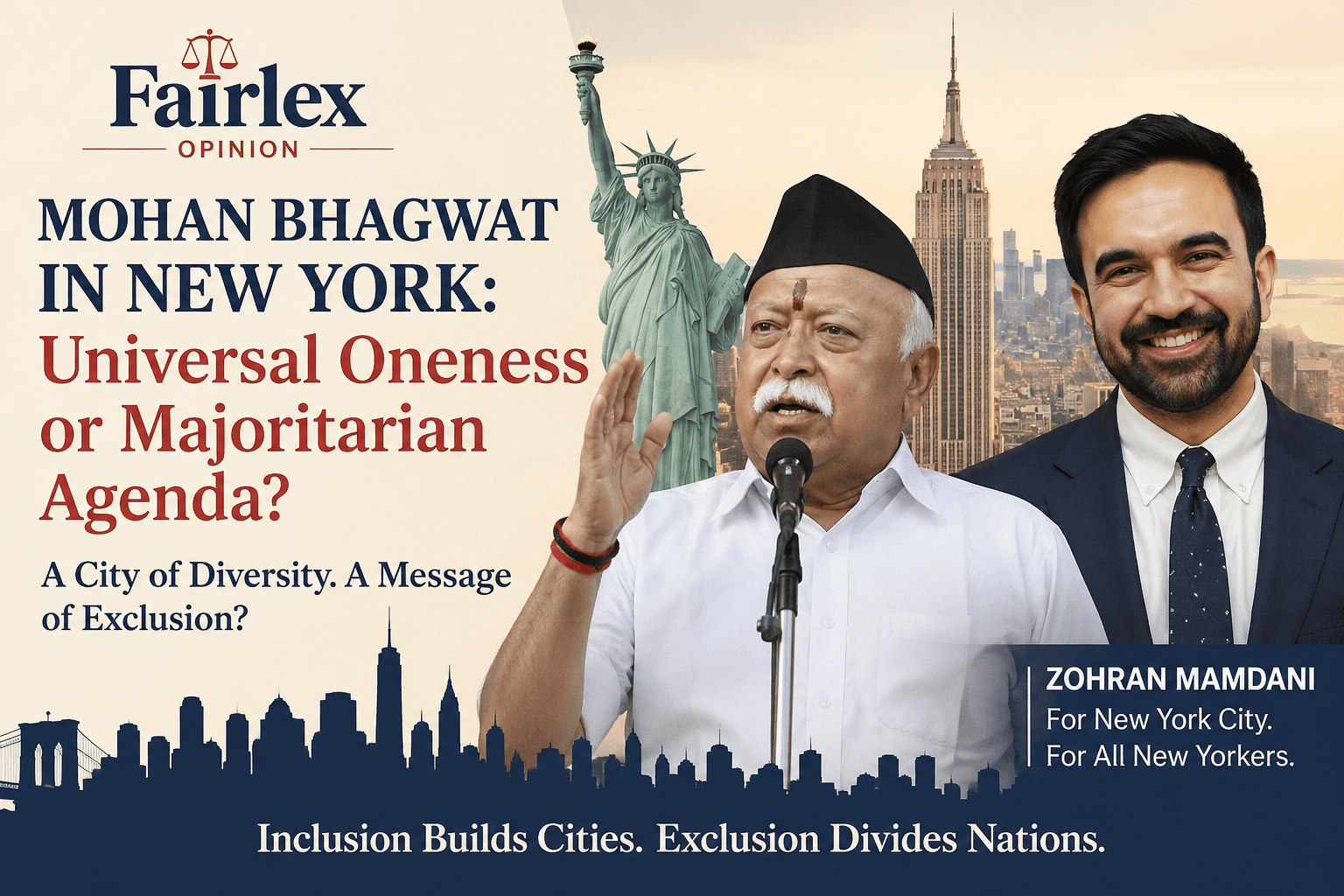
THE TRANSGENDER PERSONS AMENDMENT ACT, 2026: RETROSPECTIVE ERASURE AND THE UNRAVELLING OF NALSA
Listen to Article
Prabhat VoiceListen to natural Indian English narration
Authored by Viraj Saxena, a 2nd-year student at National Law University, Odisha
SUMMARY:
In the case of National Legal Services Authority v Union of India (2014), the Supreme Court of India held that transgender persons shall be regarded as a “third gender”, and the self-determination of gender identity is protected under Articles 14, 19 and 21 of the Constitution of India. Thereafter, the Transgender Persons (Protection of Rights) Act, 2019was enacted, which, though inadequate, recognised this principle by granting the statutory right of self-perception of gender identity under Section 4(2). The Transgender Persons (Protection of Rights) Amendment Act, 2026, eliminates this right by replacing it with a mandatory certification by a medical board and, through a retrospective proviso, excludes the people who fall outside of the scope of the new definition. This article tries to explore how the 2026 Amendment not only restricts the scope of NALSA but also seeks to negate its constitutional foundation, along with the issues surrounding the provision of retrospectivity, right to privacy, equality and failure of the amendment to pass the Puttaswamy proportionality test, and current proceedings before the Supreme Court of India.
A HISTORY OF EXCLUSION
Despite the guarantee of equality under Articles 14, 15 and 21 of the Constitution of India, the transgender community, in particular the Hijra community, was still facing severe oppression. This was partly because of the colonial era Criminal Tribes Act of 1871[1], which declared "eunuchs" a criminal sect, and because this stigma has survived beyond the repeal of the Act in 1952. Many were denied access to education, health care and work and resorted to begging (badhai) or sex work to make ends meet. Police also regularly used Section 377 of the IPC to harass transgender people, subjecting them to extortion, violence, and arbitrary arrest. This took a turn in 2014 when the Supreme Court in the National Legal Services Authority v Union of India (NALSA) case treated transgender individuals as a "third gender" and abandoned the "Biological Test" introduced in the English case of Corbett v Corbett (1970). The psychological test was established based on a deep inner feeling of a person about himself/herself. As stated in Para 74 by Justice K. S. Radhakrishnan, the question as to what gender a person belongs to is a personal choice to be made by the person concerned in the context of Article 21[2]. Furthermore, the Court integrated Yogyakarta Principle 3, which ensures that individuals of diverse sexual orientations and gender identities enjoy legal capacity everywhere, and prohibits forcing people to undergo medical procedures to legally recognise their gender. Later, the Transgender Persons (Protection of Rights) Act, 2019 came into existence, but certain sections like Sections 5, 6 and 7 were highly criticised.
KEY CHANGES INTRODUCED BY THE 2026 AMENDMENT
The 2026 Amendment restructured the 2019 Act across four areas. First, Section 2(k) replaced the earlier definition with a biology-based definition together with a list of socio-cultural groups, namely kinner, hijra, aravani, and jogta, while not considering sexual orientation within its ambit, but including persons who have been forced into surgery or mutilation. Second, Section 4(2) of the 2019 Act, which granted the statutory right to self-perceived gender identity, has been deleted outright, and the substituted Section 6 now conditions the grant of a gender identity certificate on a recommendation from a medical board headed by the Chief or Deputy Chief Medical Officer before the District Magistrate grants the certificate. Third, Section 7 continues to govern the certificate a person may seek following gender-affirming surgery, and this is now supported by the newly inserted Section 7(1A), which requires the medical institution concerned to furnish the District Magistrate and the authority with details of the surgery. Fourth, Section 18 has added harsher punishments for involuntary genital mutilation: where the victim is an adult, there is a sentence between ten years of imprisonment to imprisonment for life, while imprisonment is mandatory for life where the victim is a child. Also, forced begging leads to punishment of five to fourteen years’ imprisonment based on the age of the victim.
CONSTITUTIONAL CONFLICT
Four doctrinal fault lines follow from this. First, self-identification under Article 21. NALSA's holding was not merely a statutory privilege that the legislature could withdraw, but rather reflected a dimension of personal autonomy, effected by Yogyakarta Principle 3. The 2026 Amendment does not merely change the way the recognition procedure will be conducted; it moves the scene of the determination from the individual to the state, which is precisely what NALSA pre-empted. Second, equality under Articles 14, 15 and 16. NALSA urged that transgender individuals be considered a socially and educationally underprivileged class for affirmative action initiatives in the state. The Equality mandate in the 2026 Amendment is aspirational, with no conditions of eligibility, amount or means of implementation mentioned. CJI Surya Kant's argument in the May hearing that self-identification might be abused to avail of reservation benefits was answered by saying there is no reservation as such, and therefore, the certification regime is addressing a problem that has not arisen yet, at the same time depriving a right that has. Third, the right to privacy/dignity under Puttaswamy. If there is any violation of information privacy, then the three-part test in K.S. Puttaswamy v Union of India (2017) should be satisfied, namely, sanction by law, a legitimate state aim, and proportionality. There is neither a time limit on the use of Section 7(1A), nor a data protection safeguard specific to the record, nor a sunset or appeal clause to exclude surgical details from the permanent administrative record, even though the District Magistrate is required to receive the details of the surgery. Even if there was a legitimate state interest in preventing coerced surgeries, the proportionality limb is hard to meet where there is a blanket reporting obligation for all surgical gender-affirmation procedures, including coerced surgeries, and where, as counsel pointed out in the May hearing, people who are already on hormonal therapy have had their treatment interrupted until they are certified. The administrative-convenience justification the government offers for centralised reporting was substantially the same justification the Court rejected in Navtej Singh Johar v Union of India (2018), with reference to the case of Justice K.S. Puttaswamy v Union Of India (2017),[3] as a ground for compromising a constitutional guarantee.[4] Fourth, the most constitutionally vulnerable feature of the 2026 Amendment, i.e., its retroactive application. The proviso to the new definition clarifies[5] that people who are transgender but not included in the categories enumerated in the Act shall not be covered, and none shall have ever been covered, by the protection afforded by the Act. (Covered in depth in the next section).
THE RETROSPECTIVITY PROBLEM
The proviso to the new definition is not a withdrawal of a statutory benefit to which Parliament is always entitled. Instead, it is an attempt to make a declaration as a matter of law that a status recognised and certified by the 2019 Act never existed. It is perfectly fine for a statute to prospectively repeal or restrict a statutory class because Parliament can always choose to stop providing some benefit. But when a legislature attempts to retrospectively void the statutory status of a benefit that has been acquired according to the previous law, it has to overcome the presumption of non-retrospectivity, which requires express language to construe the statute as one that would have a retroactive effect. In the present case, that presumption becomes even stronger than usual because the proviso does not contain any express retroactivity language except the simple statement that the relevant status “never existed,” and even if it did, it wouldn’t fix the problem anyway because of the deeper constitutional dimension involved in the present case, which stems from the fact that the retroactively erased status is linked to Article 21 dignity and autonomy interests that have been already realized through NALSA and 2019 Act. More than 32,000 certificates of identity have been issued since 2019, and the Amendment does not include any transitional or saving provisions for those who received certificates of identity before the Amendment was passed but now no longer qualify under the amended definition.
LITIGATION UPDATE
Nine petitions under Article 32 currently challenge the Amendment before the Supreme Court, led by petitioners including Laxmi Narayan Tripathi, Zainab Patel, Santa Khurai, and Akkai Padmashali. At the first hearing on 4 May 2026, a bench of CJI Surya Kant and Justice Joymalya Bagchi declined interim relief while reasoning that an un-notified Act does not yet qualify as "law" capable of being stayed under Article 13 and issued a notice returnable in four weeks to the Union and all States, and referred the matter to a three-judge bench. Senior Advocate A.M. Singhvi, appearing for the petitioners, argued that the Amendment "eliminates the concept of self-recognition, self-certification" and that undergoing gender-affirming treatment without prior board certification has itself been made an offence.
The litigation has since escalated. Parallel challenges were also filed before the Kerala, Delhi, Karnataka, and Bombay High Courts, along with a separate petition by two trans men challenging their exclusion from the Act's protections. In June 2026, a bench of CJI Surya Kant and Justice V. Mohana stayed all proceedings pending before these High Courts and issued notice on the Centre's plea to transfer every pending challenge to the Supreme Court itself, to avoid divergent rulings on the same constitutional questions.
“The picture has shifted further since. On 3 August 2026, a bench of CJI Surya Kant, Justice Bagchi, and Justice V. Mohana orally observed that the 2026 Amendment, being prospective legislation, cannot be construed to strip transgender persons of vested rights, including identity cards already issued under the 2019 Act, and directed the Union to respond, posting the matter for further hearing. At the following hearing on 17 August, the Union government formally assured the Court that identity cards issued before the Amendment would continue to operate pending the outcome of the proceedings, while the Solicitor General sought four weeks for the Centre's final response on the substantive challenge. These remain oral observations and an interim assurance rather than a final ruling, and they leave the retrospectivity problem in the text of the proviso unresolved. But for the moment, the more accurate account is one of the Court actively resisting the retroactive erasure of vested status, not settling into it.”
IMPACT AND UNRESOLVED PROBLEMS
The Amendment indeed has some positive features. It extends anti-discrimination protections to education, health care, workplaces and the housing sector, strengthens the penalties for serious acts of discrimination against the community, and raises the profile of transgender people in representative institutions like the National Council. Yet these gains are set against the backdrop of unaddressed structural issues which cannot be addressed by legislation alone: Registration is inaccessible to people who lack documentation, and caste, class and regional inequalities further exacerbate discrimination against transgender people that cannot be remedied through registration reforms. The framework of the Amendment has not received much attention in terms of poverty alleviation within the community.
CONCLUSION
It is hard to see how the extension of protection in the Amendment can redress its profound constitutional fault: it does not merely regulate the gender recognition procedure but, through the proviso's retroactive effect, attempts to erase a status already conferred by settled law. It remains to be seen if this will stand up to rigour, because either the Supreme Court has applied a 'floor' principle in its self-identification holding, meaning Parliament cannot legislate below it, or because the right is itself a legislative creation, giving Parliament ample leeway to reconstruct it. The stronger constitutional interpretation supports the former view. Existing certificates remain, for now, protected by the Court's own intervention, but the proviso's text still contemplates their retroactive nullification, and that unresolved tension is what the pending bench must decide. Additionally, the mandatory surgical reporting has resulted in unresolved privacy issues. Until the three-judge bench rules, the more than 32,000 persons certified under the 2019 Act remain in a state of genuine legal uncertainty about whether their recognised status will survive.
[1] Criminal Tribes Act, 1871.
[2] National Legal Services Authority v Union of India (2014) 5 SCC 438, [74].
[3] Justice K.S. Puttaswamy v Union Of India (2017) 1 SCC 1.
[4] Navtej Singh Johar v Union of India (2018) 10 SCC 1, [414].
[5] Transgender Persons (Protection of Rights) Amendment Act 2026, s 2(k) proviso.
Written by
Guest Author
Contributor and legal researcher at FairLex, analyzing contemporary Indian jurisprudence, landmark judicial decisions, and legislative policy.
Continue Reading
Related Stories


Start the Conversation
Share your perspective on this article