When a Seat Is Surrendered: The Law Behind Ruhullah Mehdi's Resignation
Listen to Article
Prabhat VoiceListen to natural Indian English narration
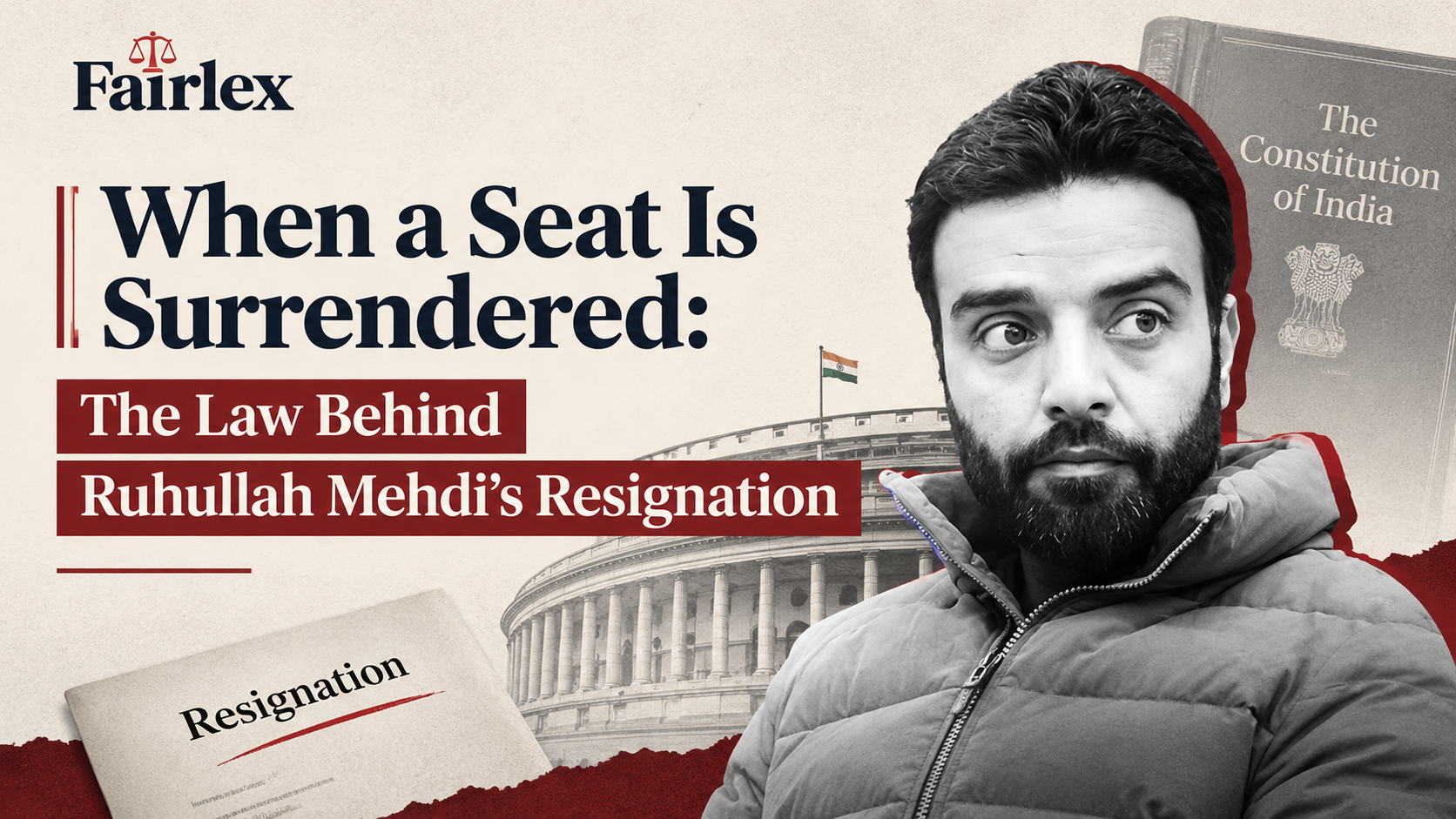
One letter to the Speaker vacated Srinagar's seat in Parliament. Between the Constitution, the anti-defection law and the six-month rule for bye-elections, the legal questions it raises are narrower than the politics, and more telling.
On 3 November 2026, Aga Syed Ruhullah Mehdi wrote to the Lok Sabha Speaker, resigning from the 18th Lok Sabha. At a public rally he also announced that he was leaving the National Conference (NC), a regional political power in J&K. A Lok Sabha Secretariat notification, S.O. 6067(E) published in The Gazette of India, Extraordinary, Part II - Section 3(ii), later confirmed the Speaker's acceptance with effect from 3 November, and the Srinagar seat fell vacant. Stripped of politics, the episode is a compact lesson in three areas of law: resignation, anti-defection and bye-elections.
A Right With a Gatekeeper
Article 101(3)(b) lets a Member of Parliament resign by writing, under his hand, to the Speaker. The 33rd Amendment of 1974 added a proviso. If, after such inquiry as he thinks fit, the Speaker is satisfied that the resignation is not voluntary or genuine, he shall not accept it.
In Shrimanth Balasaheb Patil, the Supreme Court read this narrowly. A legislator has a right to resign, and the Speaker's inquiry is confined to authenticity ("genuine") and the absence of coercion ("voluntary"). It does not extend to the member's motive.
Measured against that test, Mr. Mehdi's resignation is unremarkable. It was written, announced publicly and, by reports, shared online. The NC has alleged that the BJP executed "Operation Lotus". That is a political charge. Even if proved, an allegation of inducement goes to motive, which the Speaker may not weigh. The law asks only whether the letter is authentic and free of compulsion.
The Tenth Schedule Question
Leaving a party and a seat together invites a Tenth Schedule enquiry. Paragraph 2(1)(a) disqualifies a member who voluntarily gives up membership of the party that set him up as a candidate. Resigning the seat ordinarily moots that exposure. Yet Shrimanth Patil held that resignation does not erase a disqualification whose cause arose earlier, and the Speaker may still decide it.
The same judgment also held that Tenth Schedule disqualification does not, by itself, bar a person from contesting a fresh election. On that reasoning Mr. Mehdi is free to seek a fresh mandate.
The Bye-election Clock
Section 151A of the Representation of the People Act 1951 requires a bye-election within six months of a vacancy. There are two exceptions. The first applies if less than a year of the term remains. The second applies if the Election Commission, in consultation with the Centre, certifies that holding the poll within that period is difficult.
A Lok Sabha's term runs five years from its first sitting. The 18th sat in June 2024, so well over two years remain.
In Pramod Laxman Gudadhe, the Supreme Court treated the six-month command as binding where at least a year remained. It stressed that Parliament did not intend a constituency to stay unrepresented, and it refused to accept the burden on the exchequer as a ground for delay. The poll is therefore due by early May 2027. Only the "difficulty" certificate could defer it, and an exceptional power should not become a convenient one.
A Reflection From Srinagar
Three thoughts stay with me.
First, the Constitution makes exit easy for a representative but offers voters no recall. The seat belongs to the 3.56 lakh people who voted for it in 2024, not to any individual. Their only legal safeguard is a prompt bye-election.
Second, the anti-defection regime is often described as a wall. This episode suggests its limits: it polices the manner of leaving more than the fact of leaving.
Third, Srinagar knows the cost of thin participation, as turnout in 2019 was 13 per cent. Half a year without a voice in Parliament is a long silence for this constituency. Whether Mr Mehdi's reasons are persuasive is for the electorate to judge. The Election Commission's duty is to ensure it gets to judge soon, and fairly.
Written by
Mohammad Yasir Bhat
Contributor and legal researcher at FairLex, analyzing contemporary Indian jurisprudence, landmark judicial decisions, and legislative policy.
Continue Reading
Related Stories


Start the Conversation
Share your perspective on this article