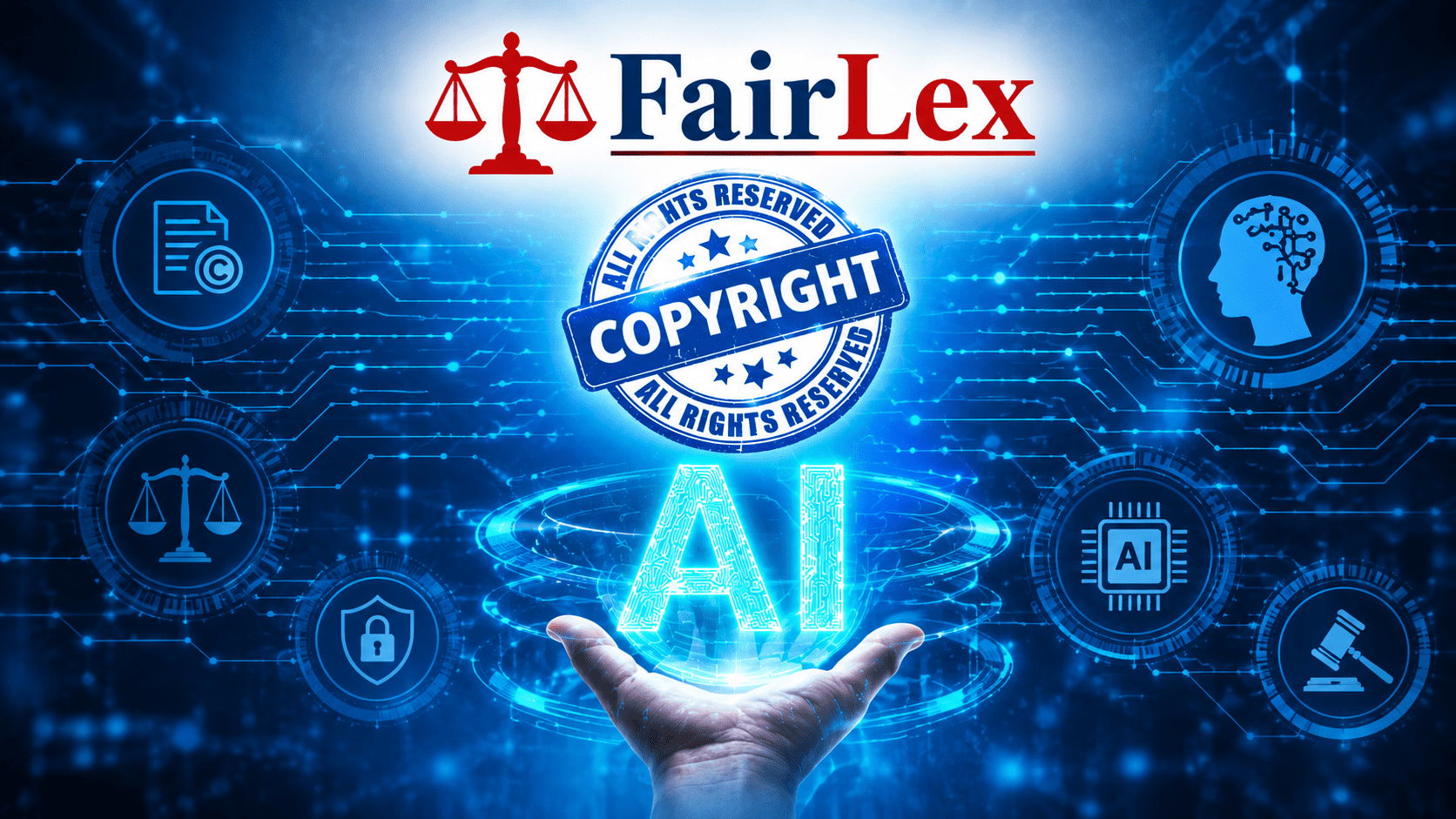
Who owns AI-generated content? Rethinking copyright ownership in the age of generative AI
Listen to Article
Prabhat VoiceListen to natural Indian English narration
ABSTRACT
Generative AI has made it easy for anyone to produce images, text and designs, but the law has not settled who, if anyone, owns the results. This article examines the answers emerging across jurisdictions. It begins with the United States, where Thaler v. Perlmutter, 130 F.4th 1039 (D.C. Cir. 2025), cert. denied, No. 25-449 (U.S. Mar. 2, 2026) and the Copyright Office’s 2025 report tie protection to human authorship and treat prompting alone as insufficient control. It then considers platform terms of service, which confer contractual rather than copyright ownership, and compares the divergent approaches of China and the United Kingdom, where the future of section 9(3) of the Copyright, Designs and Patents Act 1988 is uncertain. It also links output ownership to the unresolved question of training data. The article closes with reform options and practical steps creators can take now.
Keywords: Artificial intelligence; copyright; authorship; generative AI; Thaler v. Perlmutter
I. INTRODUCTION
Imagine an evening spent coaxing the image generator to produce your ideal book cover. It takes forty prompts before the image is generated exactly as you envisioned. You post it, but someone steals it to use it in their project, and immediately you react: That’s actually mine! Here comes the bad news. You may have no legal basis for that claim. As much as generative AI technology has made it easy for anyone to produce content, the copyright laws were developed based on an implicit understanding that there is always a human behind each and every piece of creation made. This understanding has been challenged multiple times in courts, copyright offices and even legislatures around the world. So, who owns the work created by an AI system?
II. THE U.S. STARTING POINT: NO HUMAN, NO COPYRIGHT
The fundamental rule is that authorship is by human beings. Stephen Thaler, a computer scientist, sought in Thaler v. Perlmutter to register a picture generated by his program, the Creativity Machine, in the name of the AI as the sole author of the picture. The D.C. Circuitsupported the Copyright Office, and on March 2, 2026, the Supreme Court refused to hear the case, leaving the human authorship requirement standing. The lower court called it a “bedrock requirement of copyright."
It is imperative to be clear about what Thaler decided and what he did not decide. As he disavowed any human intervention, the courts were spared having to decide what level of human intervention would be required. One commentator says it very directly that a raw AI-generated image, standing alone, has no copyright owner. However, the decision does not address thefundamental question of whether someone who triggers or instructs the system may be considered an author, which is really what we are all interested in knowing. Thaler’s attorneys were concerned that the refusal might hurt AI development and use in the creative industry. Whether that seems like alarmism or wisdom of the future is subjective, but it is indicative of the struggle. If too little is protected, creators may feel reticent about making use of new technology; if too much of it is protected, machine-produced works might outdo humans altogether.
III. WHERE DOES THE LINE FALL? PROMPTS VERSUS CREATIVE CONTROL
The Copyright Office addressed this in a report published in January 2025, Copyright and Artificial Intelligence, Part 2: Copyrightability. Based on current technology, the report concluded that prompting does not provide sufficient control to the user. Prompts act as directions through which concepts are communicated, and since the same prompt can produce many different outputs, the system determines the expressive nuances, not the user. Selecting a favorite from the group does not alter this fact because selecting a single output is not in itself a creative act.
What eventually counts? Human-created material that is visible in the output, as well as the choice, arrangement or alteration thereof. In the case of the classic example, the comic book Zarya of the Dawn, the Office protected the human-authored text and the arrangement of the images, but not the AI-generated images themselves. It is like a compilation: protection coverswhat you made, not what the machine made. Not everyone agrees with that interpretation. According to reports, artist Jason Allen’s prize-winning image took over 600 prompts, and he argues that AI is just another tool, like a camera. His challenge to the Office’s refusal is pending in a Colorado federal court, and a ruling could clarify where the line really lies.
IV. “BUT THE TERMS OF SERVICE SAY I OWN IT”
Most of the companies say so in their terms. In the case of OpenAI, the terms specify that the user owns the output and the company assigns you whatever rights it has, "if any". Sounds comforting, but a firm can give away only those rights that it owns. According to one legal interpretation, this means that you get contractual ownership, which is different from copyright. Contract resolves issues between you and the platform; it is incapable of creating a copyright that does not exist legally, nor does it do anything to deter someone else from copying your image. Even OpenAI recognizes in its own contract that the product might not be unique, as other users might receive the same product.
V. DIFFERENT ANSWERS FOR DIFFERENT COUNTRIES
However, when one looks further afield, things become even more complicated. In the case of Li v. Liu (2023), decided by the Beijing Internet Court, a work made using Stable Diffusion received copyright protection because the plaintiff kept adjusting prompts and parameters until the image matched his vision. The court also held that the AI model’s designers are not the authors. It's a workflow that U.S. officials treat with far more skepticism. The United Kingdom has the strangest story. Since 1988, section 9(3) of the Copyright, Designs and Patents Act has given authorship of computer-generated works to the person who undertakes the arrangements necessary for their creation, with 50 years of protection. But in March 2026 the government indicated that it is inclined to repeal that provision, subject to further evidence, after most online consultation respondents opposed protecting purely machine-made works, while keeping protection for AI-assisted work.One of the few countries with a statute written for this problem may be about to abandon it.
VI. THE OTHER OWNERSHIP QUESTION: WHOSE WORK TRAINED THE MACHINE?
While output ownership garners the headlines, input ownership has its own battles to fight. In Bartz v. Anthropic, the court ruled that training on legally purchased books constituted fair use, whereas downloading and retaining pirated versions did not. The matter was settled for $1.5 billion, given final approval in July 2026, at roughly $3,000 per book. Meanwhile, the UK confirmed it would not introduce a broad AI training exception. The two questions are inherently linked. The fact that the machine output may not be covered by copyright, even though authors’ works were used to create the machine itself, creates an imbalance of sorts from the perspective of ethics.
VII. RETHINKING THE FRAMEWORK
What can come of that? Some possibilities include the following: First, maintain human authorship, but refine the test. Case-by-case analysis is adaptable but difficult to predict, and clearer guidelines about what level of control suffices would be helpful to creators. Second, encourage the process rather than the product alone. It is the iterative process that distinguishes tool use from vending machine output, which was key in the Chinese case. Third, do not create rights based purely on machine output. Weak or non-existent protection would avoid an influx of low quality machine-made work competing against human-made work, which is a concern raised repeatedly in the UK consultation. Fourth, link output guidelines to training guidelines. Licensing and openness about training data should be addressed at the same time as the ownership of output.
Finally, there is one more dynamic that needs to be mentioned. The Copyright Office concluded that there are no legal gaps that need filling in regards to dealing with AI generated output, as the current doctrine is sufficiently flexible. This might be true in regard to existing technology. However, as systems allow users to have more control over all the components of an image or a written draft, the divide will keep changing. None of this will arrive quickly. The D.C. Circuit itself acknowledged that Congress could revisit these questions. If the need for a human author becomes counterproductive, then legislation will become the probable way forward rather than litigation.
VIII. WHAT CREATORS CAN DO NOW
Creators can take some practical preventive measures. Document all your prompts and drafts and revisions. Include human input in the form of editing, organizing, painting and arranging on top of whatever the machine comes up with. Be clear about your use of AI when you register, because AI-generated elements are excluded from claims. Don’t treat a platform’s terms as asubstitute for copyright you do not have. For commercially important works like brand identity, a book, or product design, consult a copyright lawyer before proceeding.
IX. CONCLUSION
At the moment, the answer to “Who Owns AI-Generated Content?” is unsatisfactory but clear. Inthe jurisdictions examined in this article (the United States, China and the United Kingdom), copyright protects the human contribution while leaving the contribution of a machine unprotectable, and the dividing line is yet to be defined. The real question here is what we want copyright to do in the age of inexpensive creation. Copyright law has many functions: rewarding effort, protecting investments, or safeguarding human creativity. Whichever it is, the choice will determine whose efforts will be rewarded in future years. In the meantime, there is no need to wait for court rulings or legislation to begin documenting your efforts.
Written by
Abhigyaa Singh
Abhigyaa Singh is a recent graduate of Symbiosis Law School, Noida (BA LLB, 2021-26). Abhigyaa’s interests include research and writing, technology and AI law, and dispute resolution, particularly arbitration.
Continue Reading
Related Stories

Start the Conversation
Share your perspective on this article