MU VC’s Son Gets Assistant Professor Post: Natural Justice Under Scrutiny
Listen to Article
Prabhat VoiceListen to natural Indian English narration
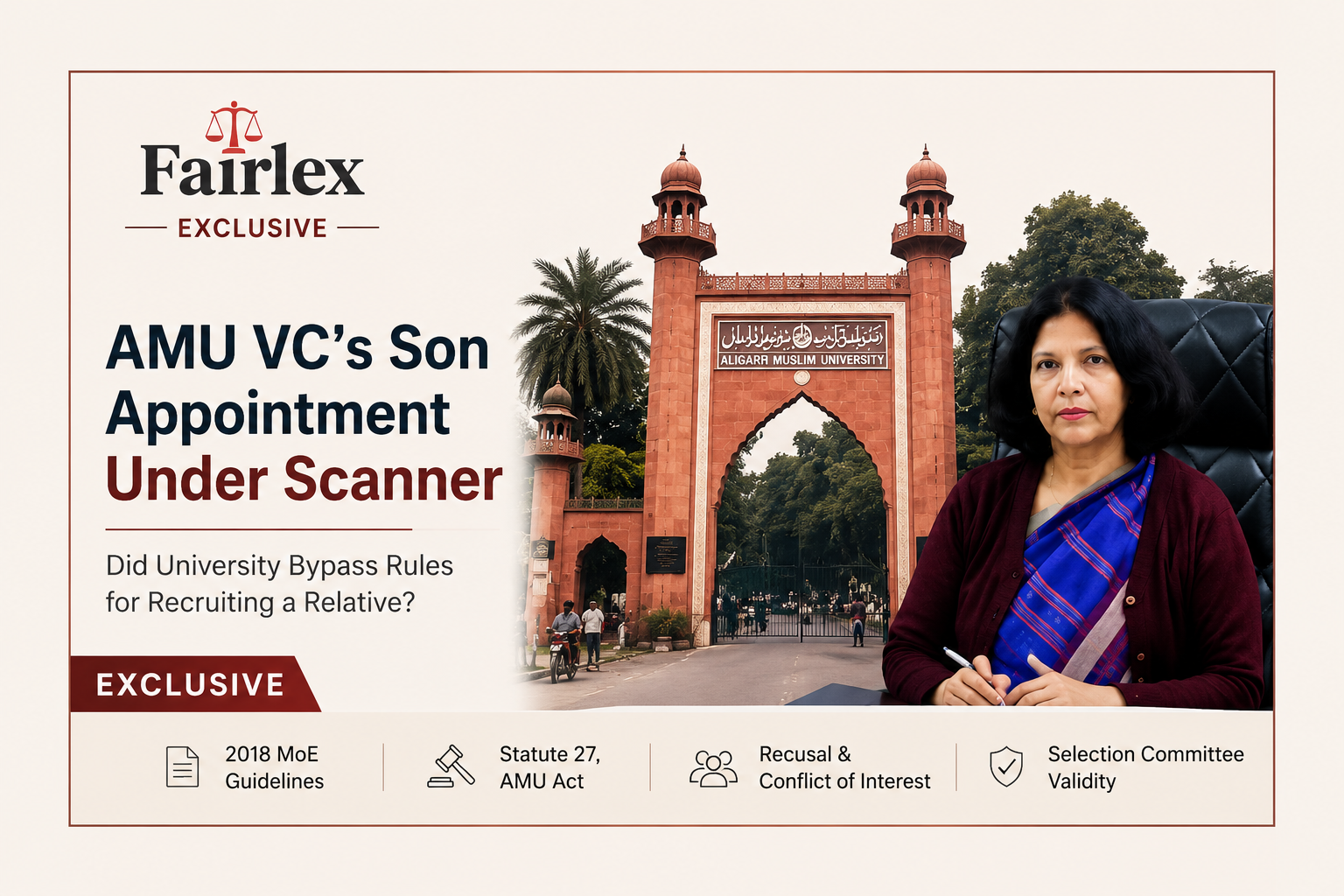
The appointment of Ali Faran Gulrez, son of Aligarh Muslim University (AMU) Vice-Chancellor Prof. Naima Khatoon, as an Assistant Professor in AMU’s Department of Law has triggered a dispute that goes considerably beyond the question of whether a university head personally participated in selecting a relative. Gulrez was appointed to a five-year, tenure-based position under the Dr B.R. Ambedkar Chair, with the appointment letter issued on 16 July 2026 after a General Selection Committee meeting on 24 June. Representations challenging the appointment were submitted to the President of India, the Visitor of AMU, and copied to the Union Ministry of Education and other authorities. The complainants allege that the appointment was made without following the safeguards prescribed for recruitment involving a Vice-Chancellor’s close relative. AMU, however, maintains that the appointment was made strictly according to the governing rules: the post is funded through the Ministry of Social Justice and Empowerment and the Dr Ambedkar Foundation, the Vice-Chancellor recused herself, and the selection was conducted by a duly constituted committee.
WHO RAISED THE ALARM :
The controversy was not triggered only after the appointment became public. Syed Kaif Hasan, a former AMU law student and lawyer, had already sought to halt the process before the appointment was finalised. Hasan submitted a representation on 24 June 2026 and a second, more detailed representation on 15 July—just a day before the appointment letter was issued—addressing his concerns to the President of India, the Ministry of Education, the University Grants Commission and AMU. Drawing on information obtained through the Right to Information Act, he questioned the role of the Vice-Chancellor in approving the advertisement, alleged that the Ministry of Education and UGC had not been informed in advance as contemplated by the applicable guidelines, and called for an independent inquiry into the recruitment process. His intervention is significant because it places the controversy in a different light: the objections were raised contemporaneously with the recruitment itself, rather than being manufactured retrospectively after the appointment of the Vice-Chancellor’s son had been completed. The subsequent appointment, despite those representations, has now brought precisely the procedural questions Hasan had flagged into wider public and governmental scrutiny.
WHAT IS THE LEGAL RULE:
At the centre of the controversy is a set of Ministry of Education guidelines concerning appointments involving close relatives of the head of an institution. The guidelines, formulated in 2018 and circulated to central universities and institutions through the UGC on 1 February 2019, contemplate more than merely requiring the concerned Vice-Chancellor or head of institution to step aside. Where a close relative is a candidate, the head is expected to disclose the relationship and recuse themselves; but the guidelines also contemplate prior intimation to the Ministry so that two additional experts may be provided to the selection committee. The logic behind this second safeguard is important. A Vice-Chancellor may formally withdraw from the interview room, yet the institutional position occupied by the Vice-Chancellor can still generate a reasonable perception of influence over the selection process. The additional experts, therefore, function as an external check intended to strengthen confidence in the integrity of the selection. ThePrint has reported that the Ministry of Education has received grievances concerning the appointment and sought comments from AMU, while a Ministry source indicated that the university had not sought the appointment of additional experts from the Ministry.
AMU DEFENCE:
AMU's principal defence is that these Ministry of Education safeguards do not govern the post at issue because the Assistant Professorship was created under the Dr Ambedkar Chair scheme, which is administered by the Dr Ambedkar Foundation under the Ministry of Social Justice and Empowerment. AMU has described the post as distinct from posts created or sponsored by the Ministry of Education or the UGC and has relied upon the governing Memorandum of Understanding with the Foundation. That argument, however, encounters a potentially significant difficulty in the text of the Dr Ambedkar Chair scheme itself. The Ministry of Social Justice and Empowerment's revised scheme provides that the Chair Professor and Assistant Professor are to be recruited in accordance with the statutes, rules and regulations followed by the concerned university, and that appointment is to follow the procedure applicable to regular university appointments under the applicable UGC framework. The scheme further states that staff serving under the Chair are governed, in service matters, by the rules, regulations and statutes of the concerned university or institution. In other words, the fact that the money comes from the Social Justice Ministry does not, by itself, establish that the post operates in a legal vacuum separate from AMU's statutory recruitment framework.
LEGAL EXAMINATION:
This distinction is legally crucial because the 2018 UGC Regulations on minimum qualifications expressly apply to universities established or incorporated under Central, Provincial or State Acts and prescribe minimum qualifications and other service conditions for university teachers. The UGC's 2019 faculty-recruitment guidelines likewise state that higher educational institutions should follow their own Acts, Statutes or constituent documents while complying with the UGC Regulations. Therefore, AMU may have a strong argument that the particular Ambedkar Chair is governed by its special funding arrangement, but that does not automatically answer whether the university's own statutory recruitment machinery continues to apply. Nor does it necessarily answer whether a separate Ministry of Education safeguard dealing specifically with a Vice-Chancellor's close relative can be disregarded. The legal question is consequently one of harmonisation: does the special Ambedkar Chair framework replace the ordinary recruitment procedure, or does it incorporate the university's ordinary procedure while adding a Foundation representative and other special requirements? The wording of the scheme appears, at least prima facie, to favour the latter interpretation.
The University's reliance on the Vice-Chancellor's recusal is nevertheless legally significant and prevents the controversy from being treated as a straightforward case of personal participation. AMU says Prof. Khatoon formally informed the Registrar that she had recused herself, that no file concerning the recruitment was placed before her, and that she was on leave on the date of the selection meeting. Indian administrative law does recognise recusal as an important mechanism for controlling actual or apparent bias. The Supreme Court has repeatedly held that the relevant inquiry is not merely whether a decision-maker subjectively believes that they are impartial, but whether circumstances create a reasonable likelihood or real possibility of bias. At the same time, Supreme Court precedent shows that where a close relative of a selection-committee member is a candidate, mere withdrawal from the interview may not always be enough; in Ashok Kumar Yadav v State of Haryana, the Court emphasised the need for withdrawal from the selection process in the ordinary selection-committee context. More recently, however, in Krishnadatt Awasthy v State of Madhya Pradesh, the Supreme Court considered a case involving relatives of selection-committee members and recognised that an effective recusal mechanism can remove a reasonable likelihood of bias where the concerned members genuinely withdraw and do not influence the assessment.
The AMU dispute is therefore unusual because the alleged defect is not simply that the Vice-Chancellor remained on a committee while her son was being considered. According to the university, she did not. The more substantial question is whether recusal was the complete safeguard required by the applicable rules. If the 2019 Ministry of Education directions are mandatory and applicable to the appointment, then recusal would appear to be only the first step, with prior intimation to the Ministry and the participation of two additional Ministry-nominated experts constituting a separate procedural requirement. If, on the other hand, the Ambedkar Chair's special scheme and MoU validly prescribe an exhaustive selection mechanism under which experts are supplied by the Dr Ambedkar Foundation, AMU could argue that the Ministry of Education had no role in the appointment. But that proposition must be demonstrated from the actual legal instruments; it cannot be established merely by pointing to the source of funding. The dispute thus turns upon the hierarchy, scope and interaction of the relevant instruments—not upon the label attached to the post.
A second and potentially independent issue concerns the constitution of the selection committee itself. The AMU Act and Statutes contain a detailed statutory framework for teaching appointments. Statute 27 provides for the composition of selection committees, specifies the role of the Vice-Chancellor and Pro-Vice-Chancellor, and provides for external experts nominated through the university's statutory machinery. It also provides that the Vice-Chancellor, or in the Vice-Chancellor's absence the Pro-Vice-Chancellor, presides over meetings and that meetings are convened by the Vice-Chancellor or, in the Vice-Chancellor's absence, the Pro-Vice-Chancellor. ThePrint reports that AMU relied on Statute 27 to say that the Pro-Vice-Chancellor constituted and approved the selection committee, while critics questioned whether the Pro-Vice-Chancellor possessed authority to nominate or approve the external experts, particularly when the Executive Council ordinarily has a role in their nomination. The precise legal effect of this objection will depend on the current text of the applicable Statute, the relevant Ordinances, the Ambedkar Chair MoU and any delegation of power. If the selection committee was constituted by an authority lacking statutory competence, the problem would exist independently of the question of the Vice-Chancellor's recusal.
This is where the controversy moves from allegations of nepotism into the more familiar territory of administrative law and institutional legitimacy. Courts generally do not sit as appellate bodies over expert selection committees and ordinarily will not substitute their assessment of academic merit for that of a properly constituted committee. The Supreme Court has repeatedly emphasised that judicial review of selections is limited, but it remains available where the process is affected by bias, mala fides, arbitrariness or a fundamental procedural illegality. The distinction matters enormously here. The question for an eventual reviewing authority would not ordinarily be whether Gulrez was academically qualified or whether another candidate was more deserving. It would be whether the selection was conducted by the legally authorised body, through the legally prescribed procedure, with the safeguards applicable to a situation presenting an obvious institutional conflict. As the Supreme Court's bias jurisprudence makes clear, the rule against bias is concerned not only with proving actual favouritism but also with maintaining confidence in impartial decision-making.
THE WAY FORWARD:
There is also a broader constitutional dimension. Public universities are not merely private employers exercising unfettered managerial discretion; their appointments are structured by statutes, regulations and public-law standards of fairness. Article 14's guarantee against arbitrariness has particular significance in public recruitment, where transparency and equal opportunity are central to the legitimacy of the process. Yet constitutional scrutiny must be balanced against the equally important principle that an allegation of a familial relationship, without more, does not prove an unlawful appointment. In Krishnadatt Awasthy, the Supreme Court cautioned against automatically inferring bias merely from a relationship where the prescribed safeguards had actually been followed and the concerned members had recused themselves. That precedent therefore cuts both ways in the AMU controversy: it supports AMU insofar as genuine recusal can neutralise a conflict, but it simultaneously reinforces the importance of identifying and complying with the prescribed balancing mechanism. If an applicable rule deliberately requires additional independent experts precisely because recusal is considered insufficient, the university cannot substitute its own assessment of what constitutes adequate protection.
Ultimately, the AMU controversy should be resolved through documents rather than competing assertions. The critical records are the exact 2018 Ministry of Education communication circulated in 2019; the revised Dr Ambedkar Chair scheme; the AMU–Dr Ambedkar Foundation MoU; the advertisement for the post; the applicable AMU Statutes and Ordinances; the resolution constituting the selection committee; the identity and source of nomination of each external expert; the Vice-Chancellor's recusal communication; and the relevant Executive Council and Academic Council records. Those documents will answer the questions that the present public debate leaves unresolved: whether the Ministry of Education had to be informed; whether its two additional experts were mandatory; whether the Ambedkar Foundation's representatives could legally substitute for them; whether the Pro-Vice-Chancellor had authority to constitute the committee in the manner claimed; and whether the committee's composition complied with both the special Chair scheme and AMU's statutory framework. Until those questions are answered, it would be premature either to declare the appointment unlawful or to dismiss the controversy as baseless. What is beyond dispute, however, is that when the son of a sitting Vice-Chancellor is appointed to a university teaching position, formal compliance is not a technical afterthought: it is the mechanism through which an institution demonstrates that merit was assessed independently and that public confidence in the selection has been protected.
Written by
Team Fairlex
Contributor and legal researcher at FairLex, analyzing contemporary Indian jurisprudence, landmark judicial decisions, and legislative policy.
Continue Reading
Related Stories

Start the Conversation
Share your perspective on this article