Section 163 BNSS Outside Jamia: Understanding the Law Behind the Restrictions
Listen to Article
Prabhat VoiceListen to natural Indian English narration
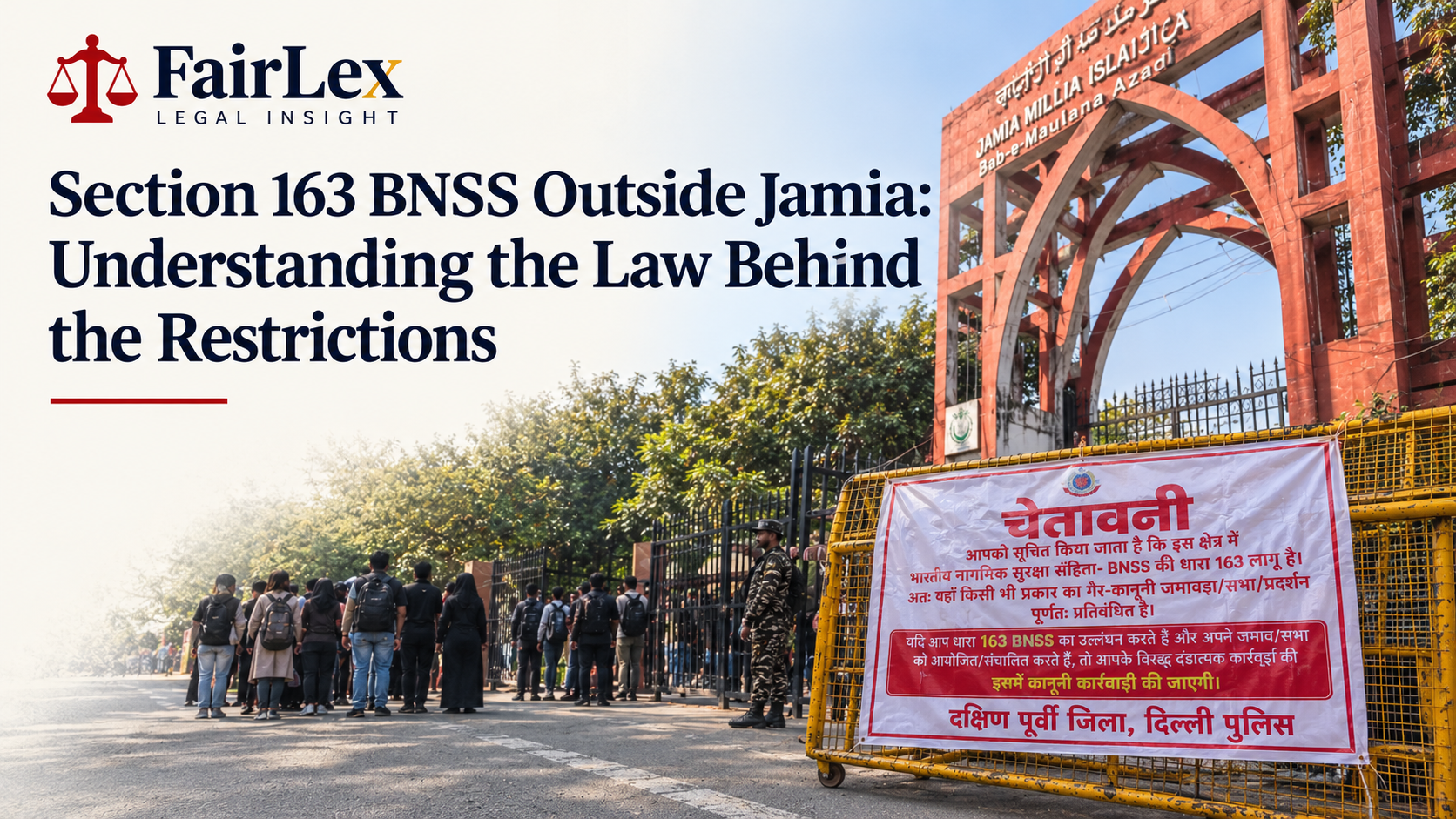
New Delhi, 27 October 2026: Delhi Police have imposed prohibitory orders under Section 163 of the Bharatiya Nagarik Suraksha Sanhita (BNSS) outside Jamia Millia Islamia, as the protest for restoring the students’ union entered its 16th day. A notice outside Gate No. 7 warns that violations will invite legal action. The order came a day after the university announced that union elections would be held once the union’s constitution is approved. (Source: The Tribune)
What is Section 163?
Section 163 BNSS is the successor to Section 144 of the CrPC. It lets an Executive Magistrate pass an immediate order where there is apprehended danger or nuisance and a speedy remedy is needed. The listed grounds are obstruction to lawful persons, danger to human life, health or safety, disturbance of public tranquillity, and riots or affrays.
The key word is preventive. The provision exists to stop a threat before it turns into a crime, which is why an order can be passed ex parte in an emergency. That power is also why it has limits. An order ordinarily lasts two months, the State Government can extend it up to six months in specific cases, and anyone affected can apply to have it altered or withdrawn.
The Article 19 problem
Article 19(1)(a) protects free speech, and Article 19(1)(b) protects the right to assemble peaceably and without arms. Both are subject to reasonable restrictions, including in the interest of public order. Section 163 sits exactly on this line.
In Madhu Limaye v. SDM Monghyr (1970), the Supreme Court upheld the preventive power as a valid restriction. But in Anuradha Bhasin v. Union of India (2020), it made clear that the power cannot be used to suppress legitimate expression or peaceful democratic protest, and that orders must be reasoned, proportionate and open to judicial review.
So what about Jamia?
A protest by itself is not a threat to public order. For Section 163 to be justified, there must be material showing a real apprehension of danger, not just inconvenience or discomfort. The reports so far describe the notice but not the reasons recorded in the order, so the legal question is still open. The students maintain their agitation is peaceful, and the authority that issued the order will have to show that the restriction was necessary and proportionate.
Section 163 is a tool for emergencies. If it is used whenever a protest becomes inconvenient, it stops being a preventive measure and starts being a restriction on a fundamental right.
Written by
Mantasha Rais
Third-year law student and writer at Fairlex.
Continue Reading
Related Stories

Start the Conversation
Share your perspective on this article