The SCAORA Is Showing Some Spine, Will The Supreme Court Follow Suit?
Listen to Article
Prabhat VoiceListen to natural Indian English narration
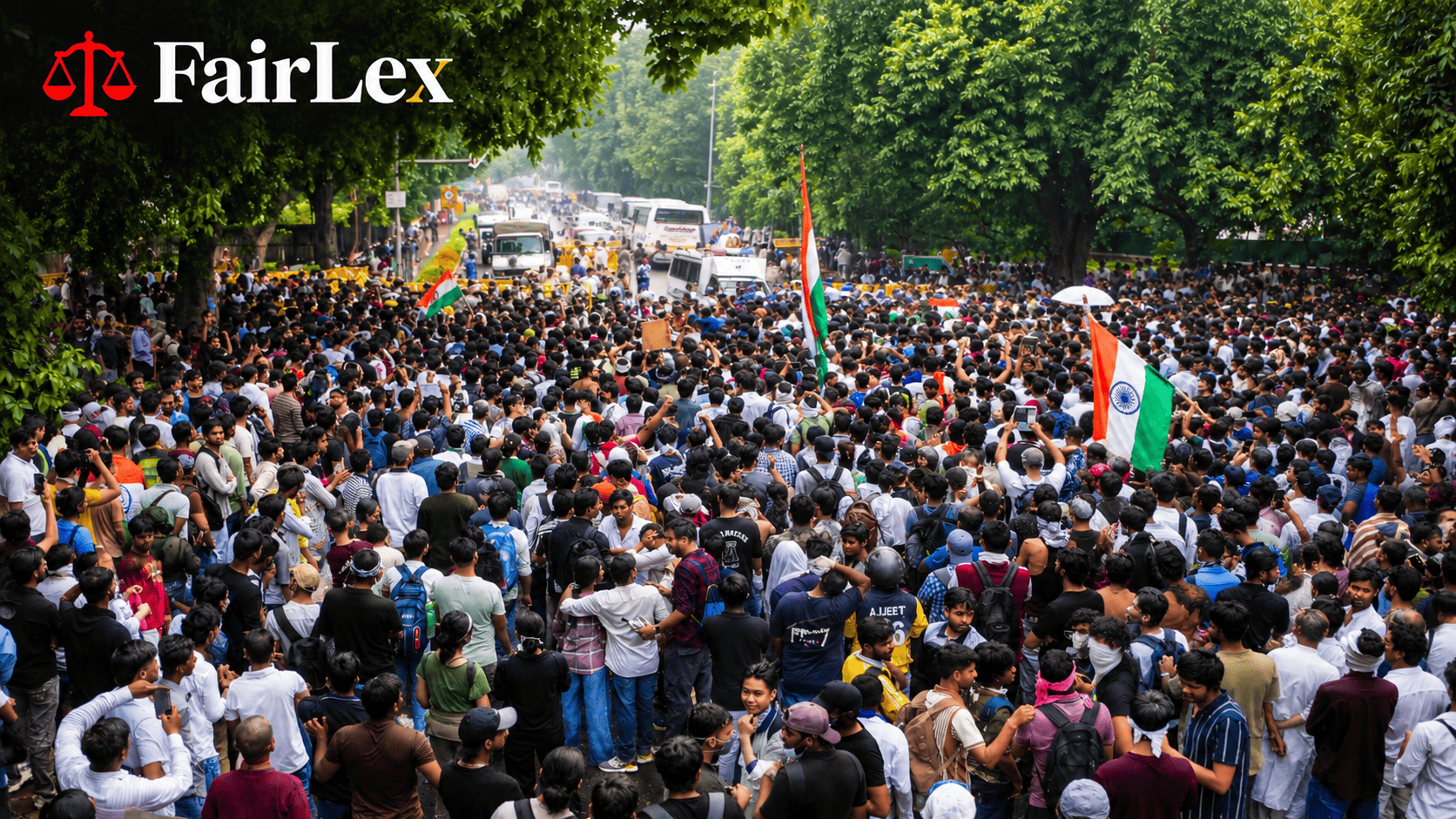
When police batons fall on the Bar, the Court must ask whose rights are really under attack: the lawyers’, or the justice system’s.
The recent protests in Delhi’s Jantar Mantar & other areas demanding the resignation of Gyanesh Kumar, the Chief Election Commissioner (CEC) of India after the shocking Indian Express expose over various incidents like SIR etc. has led to large-scale police excesses against the protesters which include a diverse variety of individuals ranging from students, political activists & most importantly for our discussion here, lawyers.
Recently, a writ petition has been filed in the hon’ble Supreme Court against the police action done against lawyers; what & when the Supreme Court decides on it will determine to a large extent whether this medium of justice would continue to be independent or be continuously intimidated by those in power.
WHAT THE ISSUE IS ALL ABOUT
On 10th October, 2026, more than 100 lawyers were detained for participating in the protests. Other than this, the protests have been marked by manhandling of women advocates by police constables not wearing any badges, putting lawyers in vans meant for criminals are just a few instances that show the level of police brutality perpetrated against the lawyers.
To put an end to all this & protect the fundamental rights of lawyers, the Supreme Court Advocates-on-Record Association (SCAORA) through AOR Anas Tanwir has filed a petition in the Hon'ble Supreme Court which argues for an independent inquiry into these matters while also ensuring that lawyers aren't intimidated for participating in peaceful protests.
At this point of time one might assume that the entire Bar is united & speaking in one voice but this isn't so simple as it appears. The divisions between the different Bar & Advocates Associations have come to the fore which has to some extent weakened this resistance against authority.
As per Adv. Anas Tanwir, these divisions are a result of certain people in the legal profession aiming for government connections & positions of favour, while at the same time putting their own brothers down in this fight against authoritarianism. He argues that such acts would lead to the propagation of a wrong notion to the public that lawyers who aren't able to fight for themselves won't be able to fight for a common man’s rights as well. He praised the Chandigarh District Bar Association for calling for a no work day but was disappointed at seeing that not a single bar association in Delhi took a similar stand. Apart from this, he criticised the Supreme Court Bar Association (SCBA) for just observing a one-minute silence as a form of protest while more concrete steps were expected & required from them.
CONCLUSION
While the petition was filed on 12th October, 2026, it is tentatively next listed on 03rd November, 2026. Until then, the condition can get either better or worse for everyone including lawyers. What remains to be seen can be better summed up through 2 different but significantly interrelated questions:
(a) Will the Supreme Court support the lawyers by ensuring that their fundamental rights are protected & they aren't intimidated to participate in such protests?
(b) Will the different Bar Associations like SCBA & SCAORA set aside their divisions & establish a united front against rising authoritarianism in India?
The answers to these questions will determine to a large extent, the future of Indian Democracy & the place of lawyers as torchbearers of justice within such a framework.
Written by
Mohammad Yasir Bhat
The author is a second-year law student at the School of Law, University of Kashmir, with a keen interest in Constitutional Law, Human Rights, History & Politics.
Continue Reading
Related Stories

Start the Conversation
Share your perspective on this article