Stuck in Traffic, Desperate for a Lane: Why India Needs Special Ambulance Routes
Listen to Article
Prabhat VoiceListen to natural Indian English narration
Rehan Bhushan is a third-year B.A. LL.B. (Hons.) student at CHRIST (Deemed to be University), Delhi NCR Campus, with a keen interest in legal research, writing, and contemporary legal developments.
An Emergency, Not an Occasional One
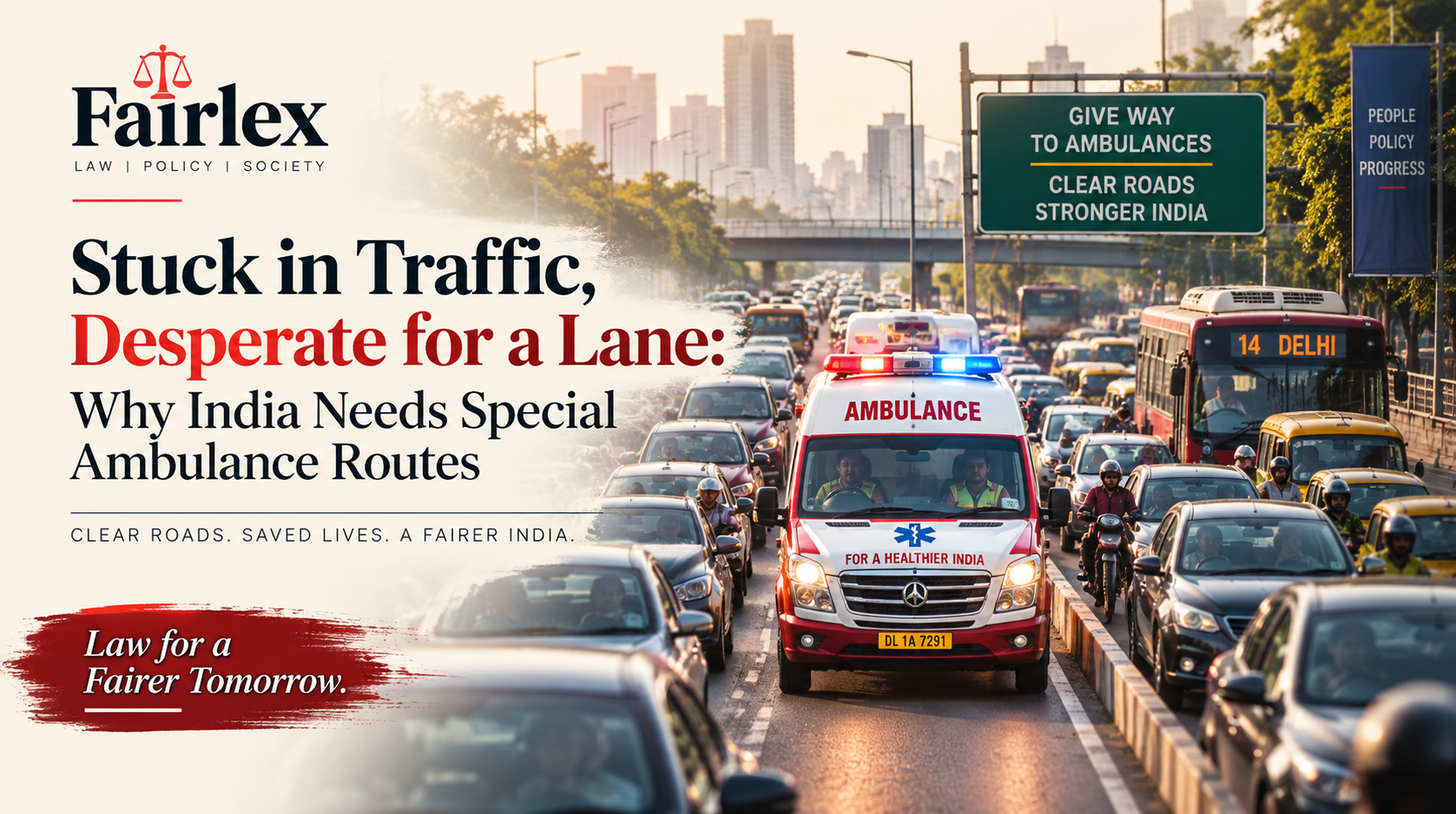
On a part of the Delhi - Meerut Road, one recent evening, more than fifteen ambulances were stuck in the same traffic jam, sirens on, patients inside, none of them moving. No VIP group caused it. No festival event, no election crowd. This was the normal everyday traffic that a person living in either of these Indian cities experiences in his or her everyday life on any weekday evening. It is this normal everyday traffic rather than any special event that poses the greatest threat to India's roadways.
The time required by an ambulance to travel from one end to another has been shown in studies conducted on various cities to be as long as fifty-three minutes in cities like Delhi, Mumbai, and Gurugram, and seventy minutes in Kolkata[i]. The findings of a study on emergency response services in the city of Delhi, conducted in 2023, showed that traffic congestion during peak hours reduces the ambulance cover rate by eight percent in a country with no standard for ambulance response rate[ii]. India's ambulances are not just occasionally delayed by newsworthy events. They are regularly delayed by normal traffic every day in every major city. The hold-ups caused by VIP groups that get headlines are the most visible sign of this bigger problem.
The Legal Basis - A Right That Cannot Be Delayed
The starting point is not traffic law but legal rules from the government. In the case of Parmanand Katara v. Union of India, the Supreme Court said that saving lives is an important thing and that no hospital could refuse emergency treatment just because there were legal papers involved[iii] by reading that duty directly into Article 21 of the Constitution[iv]. In yet another case, Paschim Banga Khet Mazdoor Samity vs State of West Bengal, it was held that the state had to set up emergency healthcare facilities[v]. In view of the right to be treated being made a guaranteed right the very moment one enters the hospital premises, it is difficult to see how it lapses in transit. Stuck in traffic or by someone else's group. The path to the hospital is a requirement for the right to be treated, not something from it.
The Legal Rules - Rules That Are Already in Place
Regulation 27 of the Central Motor Vehicles (Driving) Regulations 2017 says that an ambulance with its siren on has the right to go first[vi]. Section 194E of the Motor Vehicles Act 1988, added in 2019, makes it a crime not to let an ambulance go first with jail time up to six months, a fine of ten thousand rupees, or both[vii]. The same change also punished using sirens and lights without permission[viii]. Important because a vehicle that was blocked by a Bengaluru group in 2023 and said to be an ambulance turned out to be a hearse, and the driver was charged for breaking rules[ix]. Any solution should stop this kind of abuse while allowing real emergencies to go through.
VIP Groups: One Sign of a Bigger Problem
VIP road closures matter because they are very clear, not because they are the cause. In Bengaluru, an ambulance with a heart patient waited fifteen minutes for the minister’s group even though a local official said ambulances should go first[x]. In Delhi, a family said their father died after being stuck near Rajghat for the prime minister's group. The third such death reported in a year[xi]. In the case of Abhay Singh v. State of Uttar Pradesh, the Supreme Court said that not allowing VIP groups to use lights was against the idea of equality[xii], leading to a near ban on red lights from 2017[xiii]. It only stopped the lights, not the closing of roads. Even if all VIP group exceptions were fixed tomorrow, the fifty-three-minute traffic in Delhi would still be a problem.
When the Law Meets the Road
The same problem keeps happening because it depends on choices, not plans. The Deputy Commissioner of Traffic in Bengaluru said officers "did not hear any siren nor had any idea about an ambulance" that way [xiv]. In Hapur, a person with a heart problem died inside an ambulance stuck for four hours in a traffic jam near a train crossing[xv]. No VIP group involved. A law with no help behind it will keep failing like that, no matter how many rules are made after each death. Enforcement now asks a police officer, a person on the street, or a dispatcher to find a solution quickly; a lane, on the other hand, is already there every day, whether someone notices a siren in time.
A Better Plan - Dedicated Lanes, Checked Use
The answer must move from choices to plans. India already has a good example. Ahmedabad's Janmarg BRTS has air-conditioned buses on a road close to other cars and automatic gates open for BRTS buses and ambulances, staying closed to everyone else[xvi]. Bengaluru BBMP made a bus lane on Outer Ring Road with barriers separating it from other traffic, allowing only buses and ambulances to enter, after which officials expected speeds on that road to go up quickly from four kilometers an hour[xvii]. Similar special roads, close to cars already exist in Bhopal, Indore, and Pune[xviii]though most were made for buses, not for ambulances. If a shared bus and ambulance road already works well in one of the cities in India, there is no reason the same gate-checked plan cannot be used in every city that has the ambulance problems described above. And every existing BRT corridor in the country could be changed to allow ambulances instead of leaving that access to informal police choices at each stop.
First, use this idea on purpose. Special lanes on roads that're always busy, for ambulances, fire trucks, police cars, and BRTS-style buses using cameras to make sure no one breaks the rules. Building on the existing "green corridors" that Indian police already use for ambulance transporting organs, with Gurugram police helping fifteen such trips in one year[xix].
Second, add a way to stop use. Every ambulance that uses such a lane should be tracked by GPS, logged when it is called, and checked against a patient record like the system GVK-EMRI uses for the 108 service, with the penalty from Section 194E extended to wrong use of the lane. The exact problem the Bengaluru hearse incident showed[xx].
Third, have a plan for road closures. Rules for VIP groups and parades should include a way for ambulances to go through with a live communication channel, closing the one type of delay that can be planned.
The Golden Hour Should Not Be Left to Chance
Survival after a heart attack drops quickly with every minute lost before using a defibrillator[xxi]. At that time, a fifty-three-minute traffic jam in Delhi is not different from
a fifteen-minute hold-up by a VIP group or a four-hour jam at a train crossing. Each is, in effect, a treatment that never starts. That harm is the same as the harm the Supreme Court said was bad in Parmanand Katara. Whether the problem is a hospital gate, a highway jam, or a parade should not change the way of looking at it. And as Ahmedabad and Bengaluru bus lanes show, it does not have to stay just an idea either. What those two cities have already shown is that the choice between moving buses and moving ambulances fast is not real: the same road, the same gate, and the same camera can help both.
Conclusion
Article 21 does not stop for traffic. Parmanand Katara made saving lives the important thing; Parliament backed that with Section 194E; Abhay Singh limited the signs of VIP power; and Ahmedabad's Janmarg has already shown that a shared checked ambulance and bus lane works on Indian roads on a large scale. What is left is the will to make it happen. A camera-controlled lane on every busy road, so golden hour is a matter of engineering rather than luck on any normal Tuesday evening, as much as the day a VIP group passes through.
REFERENCES:
[i] Emergency Live, ‘Ambulance Motorcycle Services: Preparedness in Case of Traffic Jam’ (Emergency Live) <https://www.emergency-live.com/ambulance/ambulance-motorcycle-services-preparedness-in-case-of-traffic-jam/> accessed 6 September 2026.
[ii] M Singh and others, ‘Effect of Traffic Congestion on Emergency Medical Service Response Times in Delhi’ ScienceDirect (2023) <https://www.sciencedirect.com/science/article/abs/pii/S0038012123000435> accessed 6 September 2026.
[iii] Parmanand Katara v Union of India (1989) 4 SCC 286.
[iv] Parmanand Katara v Union of India (1989) 4 SCC 286; see also Legal Bites, ‘Right to Medical Aid under Article 21: Parmanand Katara’ <https://www.legalbites.in/right-to-medical-aid-under-article-21-parmanand-katara> accessed 6 September 2026, and iPleaders, ‘Medical Aid Interpreted under Article 21: Parmanand Katara v Union of India’ <https://blog.ipleaders.in/medical-aid-interpreted-article-21-parmanand-katara-v-uoi/> accessed 6 September 2026.
[v] Paschim Banga Khet Mazdoor Samity v State of West Bengal (1996) 4 SCC 37.
[vi] Central Motor Vehicles (Driving) Regulations 2017, reg 27.
[vii] Motor Vehicles Act 1988, s 194E (inserted by the Motor Vehicles (Amendment) Act 2019).
[viii] VMEDO, ‘Traffic Rules for Ambulances in India’ (VMEDO Blog) <https://vmedo.com/blog/traffic-rules-for-ambulances-in-india/> accessed 6 September 2026.
[ix] ‘It’s a Hearse Van, Not an Ambulance’ Deccan Herald (Bengaluru) <https://www.deccanherald.com/amp/story/india%2Fkarnataka%2Fbengaluru%2Fit-hearse-van-not-ambulance-2004183> accessed 6 September 2026.
[x] ‘VVIP Convoy Movement Holds Up Ambulance’ Deccan Herald (Bengaluru) <https://www.deccanherald.com/amp/story/india%2Fkarnataka%2Fbengaluru%2Fvvip-convoy-movement-holds-up-2003559> accessed 6 September 2026.
[xi] ‘Aam Aadmi Dies as PM’s Convoy Passes’ Deccan Herald (Delhi) <https://www.deccanherald.com/india/aam-aadmi-dies-pms-convoy-2537172> accessed 6 September 2026.
[xii] Abhay Singh v State of Uttar Pradesh AIR 2014 SC 427.
[xiii] Civilsdaily, ‘Curb on VIP Culture’ <https://www.civilsdaily.com/curb-on-vip-culture/> accessed 6 September 2026.
[xiv] ‘Ambulance Stuck in Traffic, Held Up’ Deccan Herald (Bengaluru) <https://www.deccanherald.com/india/karnataka/bengaluru/ambulance-stuck-traffic-held-up-2003346> accessed 6 September 2026.
[xv] ‘Heart Patient Dies in Traffic Jam’ Deccan Herald <https://www.deccanherald.com/archives/heart-patient-dies-jam-2309107> accessed 6 September 2026.
[xvi] Ahmedabad Janmarg Limited, ‘Simple Yet Powerful’ <https://janmarg.in/index.php?file=moredetail_simpleyetpowerful> accessed 6 September 2026.
[xvii] ‘Commuters to Be on Fast Lane from Nov 1 with BRTS Debut’ Deccan Herald (Bengaluru) <https://www.deccanherald.com/india/karnataka/bengaluru/commuters-to-be-on-fast-lane-from-nov-1-with-brts-debut-765350.html> accessed 6 September 2026.
[xviii] SignalPe, ‘Lane Types’ <https://www.signalpe.com/lane-types> accessed 6 September 2026.
[xix] ‘Give Way to Emergency Vehicles or Pay Rs 10,000 Fine: Gurugram Police’ The Tribune (Haryana) <https://www.tribuneindia.com/news/haryana/give-way-to-emergency-vehicles-or-pay-rs-10k-fine-gurugram-police-592884> accessed 6 September 2026.
[xx] ‘It’s a Hearse Van, Not an Ambulance’ Deccan Herald (Bengaluru) <https://www.deccanherald.com/amp/story/india%2Fkarnataka%2Fbengaluru%2Fit-hearse-van-not-ambulance-2004183> accessed 6 September 2026.
[xxi] Emergency Live, ‘Ambulance Motorcycle Services: Preparedness in Case of Traffic Jam’ (Emergency Live) <https://www.emergency-live.com/ambulance/ambulance-motorcycle-services-preparedness-in-case-of-traffic-jam/> accessed 6 September 2026.
Start the Conversation
Share your perspective on this article