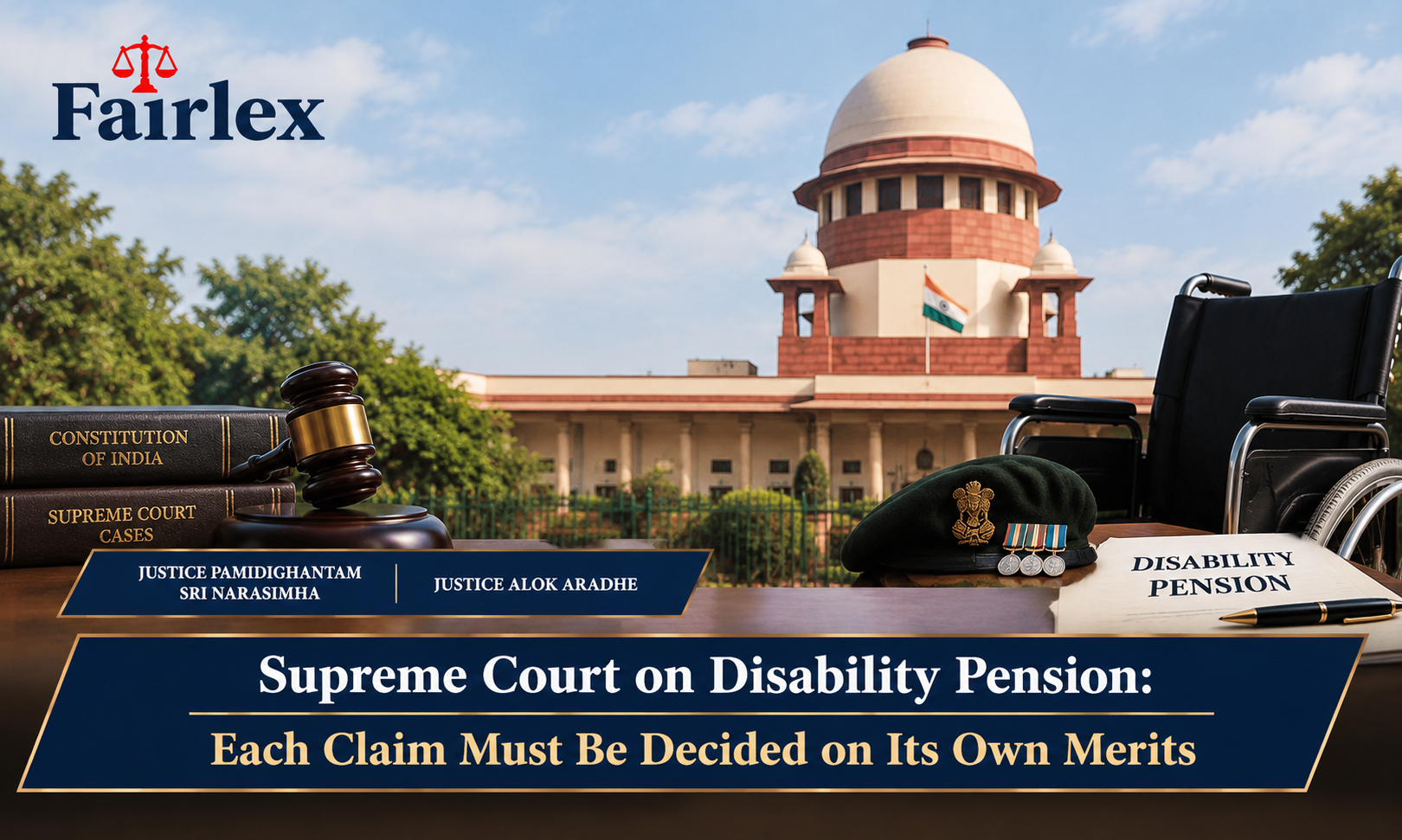
Supreme Court on Disability Pension: Each Claim Must Be Decided on Its Own Merits
Listen to Article
Prabhat VoiceListen to natural Indian English narration
1. Introduction
Judicial precedents play an important role in ensuring consistency and fairness in the administration of justice. However, a judgment cannot always be applied to every case merely because the legal questions appear similar. The facts, circumstances and issues involved in each case must also be considered. This principle was reaffirmed by the Supreme Court of India in Union of India v. Sgt. Girish Kumar, decided on 12 October 2026.
The case concerned a clarification sought by the Union of India regarding an earlier judgment dated 12 February 2026, which had granted ex-servicemen disability pension benefits, including broad-banding and interest. The Union argued that the earlier judgment was being relied upon in cases involving different factual circumstances and disputed entitlements. The Supreme Court clarified that the earlier decision could not be interpreted as granting disability pension with arrears in every case. The order highlights the importance of understanding judicial decisions in their proper factual and legal context.
2. Facts of the Case
The dispute arose from the common judgment delivered by the Supreme Court on 12 February 2026 in Union of India v. Sgt. Girish Kumar, concerning Civil Appeal Nos. 6820–6824 of 2018. In that judgment, the Court dismissed the appeals filed by the Union of India and allowed the appeals preferred by ex-servicemen.
The ex-servicemen were held entitled to disability pension, including the benefit of broad-banding with effect from 1 January 1996 or 1 January 2006, as applicable, together with interest at the rate of 6% per annum. The Union's objections based on limitation, delay and laches were not accepted.
Subsequently, the Union of India filed a miscellaneous application seeking clarification of the earlier judgment; the delay in filing it was condoned. Appearing for the Union, the learned Additional Solicitor General, Mrs. Archana Pathak Dave, submitted that in the batch of appeals the ex-servicemen's entitlement to the disability element of pension was never in dispute. They were already receiving disability pension and had merely sought its re-computation through broad-banding. According to the Union, the judgment was rendered in that specific factual context and was not intended to unsettle the principles governing stale or belated pensionary claims.
The Union also furnished particulars of 23 Air Force cases and 26 Army cases that, after the common judgment, had either been decided or were pending before High Courts or the Armed Forces Tribunal. It pointed out that in several cases, earlier final orders which had restricted arrears and had been complied with were modified in reliance on the common judgment. It contended that mechanical application of the judgment would have administrative and financial implications and unsettle matters that had attained finality, and prayed for a clarification that the judgment should not be mechanically extended to pensionary claims where entitlement to pension itself was in dispute and was later settled by Courts or Tribunals.
On the other hand, Mr. M.V.R. Mukunda, learned counsel for the respondents, fairly submitted that in the common judgment arrears from specified dates were granted to ex-servicemen who were already in receipt of disability pension and were seeking only its re-computation. He contended that the question of delay cannot be examined in isolation from the conduct of the Union of India. By way of illustration, he pointed to a case decided by the Allahabad High Court in which the ex-serviceman retired on 31 October 2011 and preferred an appeal claiming disability pension on 30 November 2011. That appeal was decided only on 11 February 2017, after about six years, so that the original application filed before the Tribunal on 30 April 2018 was well within time. He further submitted that the Union itself had approached the Court belatedly and therefore could not claim equity on the ground of delay and laches.
3. Main Issue Before the Court
The principal issue before the Supreme Court was whether its judgment dated 12 February 2026 could be interpreted as establishing a general entitlement to disability pension with arrears for all ex-servicemen, including those whose entitlement to pension itself was disputed or whose claims had already been decided by courts or tribunals.
The Court was required to clarify whether the earlier ruling could automatically be extended to pension claims involving materially different facts and legal circumstances.
4. Court's Analysis and Reasoning
The Supreme Court examined the submissions made by both parties and emphasised an established principle of judicial interpretation: observations in a judgment cannot be read like provisions of a statute or separated from the factual context in which they were made.
The Court relied on State of Orissa v. Sudhansu Sekhar Misra, AIR 1968 SC 647, and State of Uttar Pradesh v. Mohd. Arshad Khan, (2026) 6 SCC 383. These authorities were cited to support the principle that a judgment must be understood in the context of its facts and that a material difference in circumstances may affect its precedential value.
The Court did not undertake a detailed comparison of the earlier appeals with other pension disputes, and it did not expressly record findings on limitation, delay or laches. The factual position that the ex-servicemen in the original batch were already receiving disability pension and sought only re-computation was put forward by the Union and, as the order records, fairly accepted by the respondents' counsel. The Union's further contention was that other cases involve disputes over entitlement to disability pension itself, rather than merely the calculation of an existing benefit.
The Court then stated that the judgment of 12 February 2026 cannot be construed to mean that disability pension with arrears can be claimed in every case on its basis, and that each claim shall be decided on its own merits. The Court thus issued a general clarification; it did not give the specific direction the Union had sought regarding claims where entitlement itself was disputed or had been settled earlier.
It is worth noting what the order does not do. It does not lay down a blanket rule denying relief to ex-servicemen with delayed claims, nor does it hold that previously decided pension matters can never be reopened. In the commentator's reading, the clarification is narrow: the earlier judgment cannot by itself determine claims that differ materially from the cases originally decided.
Accordingly, the miscellaneous application was disposed of.
5. Ratio Decidendi and Significance of the Judgment
Although the order is a short clarificatory order disposing of a miscellaneous application, the principle it applies is clear. The ratio of the decision is that a judicial precedent must be interpreted in light of the facts and circumstances in which it was delivered. A judgment granting a particular benefit in a specific category of cases cannot automatically be treated as establishing a universal entitlement for all cases involving similar subject matter.
The significance of this ruling extends beyond disability pension disputes. First, it reinforces the doctrine of precedent by emphasising that courts must identify the legal principle actually decided rather than apply a judgment mechanically.
Second, it promotes fact-sensitive adjudication. Pension claims may differ regarding the existence of entitlement, the nature of the relief sought, limitation, delay and the procedural history of earlier proceedings. These differences may be relevant when determining whether a precedent applies.
Third, the decision is important for administrative authorities and tribunals dealing with pensionary benefits. It clarifies that the earlier judgment cannot, by itself, justify granting arrears in every case. At the same time, the Court's direction that each claim be decided on its own merits suggests that claims should be examined individually, not rejected or allowed solely by reference to the earlier appeals.
Finally, the ruling underscores the distinction between a judgment's binding legal principle and the specific relief granted to the parties before the Court.
6. Conclusion
The Supreme Court's order in Union of India v. Sgt. Girish Kumar reaffirms a fundamental principle of judicial reasoning: precedents must be applied with due regard to their factual and legal context. The Court clarified that its earlier judgment granting disability pension benefits through broad-banding, along with interest, did not create an automatic entitlement to disability pension with arrears for every ex-serviceman.
The decision maintains a balance between consistency in judicial interpretation and the need to assess individual claims fairly. It neither removes the possibility of relief in other pension disputes nor permits the mechanical extension of an earlier ruling to materially different cases. By directing that each claim be decided on its own merits, the Court reinforced the importance of careful precedent-based reasoning in the administration of justice.
Ultimately, the judgment serves as a reminder that the authority of a judicial precedent lies not in extending its outcome indiscriminately, but in correctly identifying and applying the legal principle established by the Court.
Continue Reading
Related Stories

Start the Conversation
Share your perspective on this article