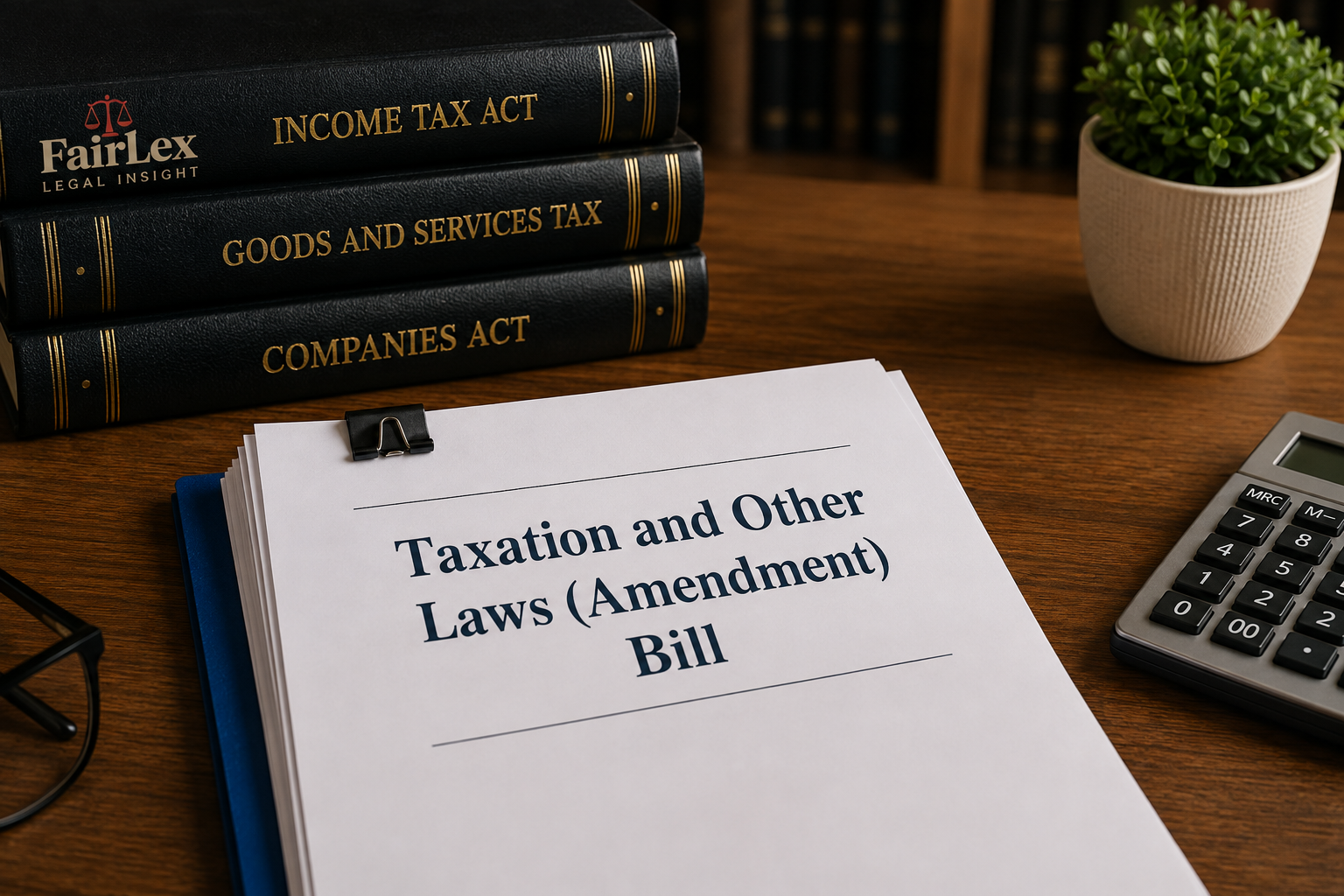
The Changing Legal Architecture of UPI Charges: Taxation and Other Laws (Amendment) Bill, 2026
Listen to Article
Prabhat VoiceListen to natural Indian English narration
Md. Zaryab Jamal Rizvi: Advocate practising before the Supreme Court of India and Founding Partner of LCZF, with nearly two decades of experience. He is a trained mediator, Board Member of the U.P. Shia Central Waqf Board, and Adjunct Faculty at Symbiosis Law School, Noida.
Izeen Fatima: Lawyer and Human Rights Panel Lawyer with the Lingering Shadows Initiative, with interests in human rights, public policy, and legal research. A published researcher and UNESCO Changemaker, she chairs Pink Legal Ibtida and holds qualifications from JMI and NALSAR University of Law.
Introduction:
The debate around UPI charges has largely been reduced to one question: will consumers have to pay for making UPI payments? But the more important question is what the Taxation and Other Laws (Amendment) Bill, 2026 (“Taxation Bill, 2026”) actually changes in the law.
But that isn't really the most significant legal question posed by the Taxation and Other Laws (Amendment) Bill, 2026. The Bill was passed by the Lok Sabha on August 6, 2026, and the Rajya Sabha returned it to the Lok Sabha on August 10, 2026, as a Money Bill, completing Parliament's consideration of the measure. It now awaits Presidential assent. The Bill proposes to alter the statutory framework governing charges on prescribed electronic modes of payment. If enacted, it would mark a shift away from a regime where such charges are expressly prohibited, towards one where their imposition can be permitted within a regulatory framework.
This distinction matters as the proposed amendment doesn't itself impose a uniform charge on every UPI transaction. Speaking in the Rajya Sabha on August 10, 2026, Finance Minister Nirmala Sitharaman said that MDR (‘Merchant Discount Rate’) would not be imposed on consumers or small merchants. This followed the Finance Ministry's clarification of August 8, 2026 that person-to-person UPI transactions would continue to remain free.
So the immediate legal issue isn't the arrival of a "UPI tax"; it's the removal of a statutory barrier that has, for several years, kept merchant-side charges away from UPI.
The article seeks to explain the proposed changes to UPI charges, why the existing zero-MDR system may change, and how the new framework could affect consumers, merchants, payment providers, and the wider digital payment system in India.
How the Zero-MDR (Merchant Discount Rate) Regime Came About
The existing zero-charge regime rests on Section 10A of the Payment and Settlement Systems Act, 2007. Inserted by section 204 of the Finance (No. 2) Act, 2019 with effect from 1st November 2019, it provides that no bank or system provider shall impose, directly or indirectly, any charge on a person making or receiving a payment through electronic modes prescribed under Section 269SU of the Income-tax Act, 1961.
Section 269SU, in turn, requires prescribed businesses above a certain turnover threshold to provide facilities for accepting specified electronic modes of payment, including UPI and QR-based payments.
Put together, the framework served two connected purposes: businesses were made to facilitate prescribed digital payments, while the payment ecosystem was barred from charging for those modes.
So the zero-MDR regime was never simply a commercial call made by banks or the NPCI — it had a legislative foundation. The practical zero-MDR position for the prescribed electronic modes took effect from 1st January 2020 through CBDT Notification No. 105/2019 and Circular No. 32/2019, both dated December 30, 20198. The circular expressly clarified that any charge, including MDR, would not apply to payments made through the prescribed electronic modes on or after January 1, 2020.
MDR is, broadly, the fee attached to processing a digital payment, and it's ordinarily the merchant who bears it, not the person paying.
This is precisely what made UPI so attractive to merchants: accepting a digital payment didn't chip away at the amount they actually received.
There was, however, a real gap between a transaction being free to the user and the transaction being costless to the system. Every UPI transaction still runs on banks, payment service providers, infrastructure, cybersecurity, fraud detection and settlement mechanisms, none of which became free simply because MDR was set at zero. The government instead propped up the ecosystem through incentive schemes. For FY 2024–25, for instance, the Union Cabinet approved a ₹1,500 crore incentive scheme for low-value BHIM-UPI person-to-merchant transactions, with incentives linked to transactions up to ₹2,000 for small merchants. 4
And the policy worked. UPI is no longer an emerging payment mechanism that needs an adoption push, it's now central to India's retail payment infrastructure. NPCI's own numbers show UPI processing over 23 billion transactions in May 2026 alone, worth close to ₹30 lakh crore.5 At that scale, the question of who actually pays to keep the infrastructure running becomes hard to keep postponing.
From Prohibition to Regulatory Choice
It's against this backdrop that the 2026 amendment needs to be read. Its significance doesn't lie in fixing a particular MDR; it lies in shifting the legal starting point altogether.
Under the existing Section 10A, the prohibition is categorical, full stop. The proposed framework would allow the government to step away from that blanket bar. The question would then shift from whether a charge can be imposed at all to the circumstances in which it may be imposed, which transactions it applies to, and what safeguards govern it.
That's a move from statutory prohibition to regulatory choice.
Reports suggest the government is weighing an MDR somewhere between 0.3% and 0.5% for higher-value transactions and merchants above certain turnover thresholds.7 These numbers, though, shouldn't be mistaken for law already in force. They're reported proposals about how a future charging framework might be designed; and that distinction matters, because a lot of the public conversation has started treating a proposed rate as if Parliament has already legislated it.
Nor does an MDR necessarily mean the person making the payment gets charged. If a merchant receives ₹10,000 through UPI and an MDR of 0.5% applies, the processing charge works out to ₹50. The formal liability sits with the merchant, who can then absorb the cost, accept a thinner margin, or fold the expense into the price of what they're selling. So the person legally charged and the person who eventually bears the cost need not be the same at all.
This matters especially for small businesses. A large retailer can absorb a percentage-based cost fairly easily. A small merchant working on thin margins may not have that luxury. The eventual framework will therefore have to look beyond who is legally charged, and ask whether that cost can realistically be passed on to consumers, and whether doing so ends up hurting digital-payment adoption.
That said, there's a fair case for revisiting the permanent zero-MDR model. Running a payment network that processes billions of transactions demands continuous investment in cybersecurity, fraud prevention, system resilience, technological upgrades are all recurring costs, and they only grow as volumes do. The government argues that relying indefinitely on incentives isn't sustainable, and that the ecosystem needs some mechanism to let participants recover at least part of what it costs to keep it running.
But the case against MDR isn't just resistance to change either. Zero transaction cost was one of the things that made UPI attractive to merchants in the first place. A small MDR is commercially manageable for a large business. For a small shopkeeper, it could become just another operating expense. If the cost of accepting UPI starts shaping merchant behaviour, the very feature that made UPI ubiquitous could take a hit.
The RBI has flagged this tension before: charges set too high discourage adoption, but prices set too low become non-remunerative and discourage investment in the ecosystem. So the real challenge isn't deciding whether UPI should be “free” or “paid”; it's working out where the cost can sit without undoing the scale and accessibility that made the system work in the first place.
| Before | After the Amendment |
| Charges on prescribed electronic modes are statutorily prohibited | The blanket prohibition is removed/modified |
| Zero-MDR is the legal starting point | A regulated charging framework becomes possible |
| Government incentives support the ecosystem | Charges could potentially supplement the existing model |
| Users generally make UPI payments without a transaction charge | P2P and small-user protection may continue, depending on the final framework |
Table showing what actually changes?
Who Ultimately Bears the Cost?
So the consumer question is more layered than whether a UPI payment will show a separate charge on screen.
If a merchant has to pay MDR, there are a few ways this can play out: absorb the cost, cut into margin, or pass some or all of it into the price of goods and services. The legal incidence may stay with the merchant, but the economic incidence can end up shared with consumers.
That's exactly why how exemptions and thresholds are designed matters so much.
Someone sending ₹500 to a friend and a large retailer processing a ₹50,000 payment may be running on the same rails, but they don't present the same economic case for being charged. A threshold-based approach could shield low-value transactions while asking larger commercial transactions to chip in towards the cost of running the network.
One reported proposal floats an MDR of roughly 0.3% to 0.5% on transactions above ₹2,000, for merchants crossing a specified annual turnover.7 Again, these are proposals, not operative law. What matters is the policy direction they point to: if a charge does arrive, it may fall mainly on higher-value commercial activity rather than apply across the board.
Government sources have suggested that the charge may, for now, be confined to large merchants, those with turnover above ₹1–1.5 crore, and to transactions above ₹2,000, which would keep it to roughly 5% of all UPI transactions.7 But the amended law itself doesn't lock that scope in. Once the statutory bar is lifted, it's the government's call how far to widen it later, and nothing in the amendment guarantees it will stay this narrow.
There's also a more practical worry sitting underneath all of this: if merchants do pass the cost on, consumers may simply drift back to cash, which, unlike UPI, costs nothing to use. A charge meant to fund digital-payment infrastructure could end up pushing people away from digital payments altogether.
That kind of differentiation could help preserve the accessibility that made UPI what it is. But thresholds bring their own headaches. Set it too low, and smaller merchants get squeezed. Set it too high, and the whole exercise may not raise enough revenue to justify moving away from zero MDR at all.
There's a competition angle here too. UPI runs through an ecosystem of banks, payment service providers, third-party app providers and merchants. Once a revenue stream enters the picture, how it's allocated could shift the commercial incentives across these different players. A charging framework that ends up favouring larger players, or that raises barriers for smaller payment providers, would raise real competition concerns.
So the question isn't just how much MDR should be. It's also how that revenue moves through the ecosystem, and whether the regulatory framework keeps the playing field level for everyone in it.
The Regulatory Questions Ahead
From a legal standpoint, the most consequential part of this amendment probably isn't the proposed MDR percentage; it's who ends up deciding it.
Parliament is changing the statutory framework. The detailed charging regime that follows will need decisions on:
● the transactions covered,
● applicable thresholds,
● rates,
● exemptions,
● collection mechanisms, and
● how the revenue is distributed.
That brings the familiar debate around delegated legislative power and regulatory accountability back into the frame.
The Payment and Settlement Systems Act already gives the RBI significant powers over payment systems, and whatever charging framework eventually emerges will have to operate within those statutory limits. Transparency around how rates and categories get decided will matter a great deal here; UPI is no longer just another commercial payment product. Its scale means regulatory decisions about it ripple through a very large part of the economy.
The government has also been clear that ordinary consumers won't be directly charged, and that person-to-person payments stay free. That addresses the most immediate public worry, but it doesn't settle the larger economic question. If merchants end up bearing an extra processing cost, market conditions, not the law, will decide whether they absorb it or pass it on.
The regulatory framework will consequently have to hold together two interests that can pull in opposite directions:
● the affordability and accessibility of digital payments, and
● the financial sustainability of the infrastructure behind them.
Which is really why calling this the “end of free UPI” is both premature and legally imprecise. What's actually changing is India rethinking how the cost of its digital payment infrastructure should be shared out.
For years, that cost was largely kept away from merchants and consumers through zero MDR and government support. This amendment opens the door to a model where certain commercial transactions may start contributing to it directly.
UPI has stopped being just a convenient payment option; it's critical digital infrastructure now. And that status comes with a genuinely difficult balancing act: the system has to stay affordable enough to keep the adoption it's built, while the institutions running it need enough incentive to keep it secure, reliable and technologically current.
So the success of this framework will hinge less on whether MDR is permitted, and more on how that permission gets used. If charges do come in, the framework will need to protect ordinary users, avoid loading disproportionate costs onto small merchants, keep competition in the ecosystem intact, and still raise enough revenue to support the infrastructure it's meant to sustain.
For more than six years, the law's answer to digital-payment charges was prohibition. This amendment changes that answer, not by making UPI a paid service outright, but by creating the legal room for a regulated charging model.
That's the real legal story here.
The debate should move past whether you'll pay for your next UPI transaction. The more important question is whether India can build a sustainable pricing model for infrastructure that millions now treat as indispensable, without letting the cost of keeping UPI alive become the reason people stop using it.
Conclusion:
The key point is that the Bill does not make UPI a paid service overnight. Instead, it removes the legal restriction that currently prevents charges on certain digital payments. The real question is now how this new flexibility will be used—who will pay, how much, and for which transactions. Any future charging system must protect ordinary consumers and small merchants while ensuring that payment providers can recover the costs of maintaining UPI. The aim should be to balance affordability with sustainability, so that UPI remains accessible, reliable, competitive, and secure without allowing the cost of maintaining the system to discourage people from using digital payments.
REFERENCES/SOURCES:-
- The Taxation and Other Laws (Amendment) Bill, 2026. Bill Summary, PRS Legislative Research. https://prsindia.org/billtrack/the-taxation-and-other-laws-amendment-bill-2026
- Section 10A, The Payment and Settlement Systems Act, 2007. India Code. https://www.indiacode.nic.in/bitstream/123456789/2082/4/a2007-51.pdf
- Section 269SU, Income-tax Act, 1961. Income Tax Department, Government of India. https://www.incometaxindia.gov.in/w/section-269su-6
- Cabinet Approves Incentive Scheme for Promotion of Low-Value BHIM-UPI Transactions (P2M), FY 2024–25. Press Information Bureau. https://www.pib.gov.in/PressReleasePage.aspx?PRID=2112771®=48&lang=2
- UPI Hits New High in May 2026 With 23.2 Billion Transactions Worth Rs 29.9 Trillion, NPCI Data Shows. ANI (Jun 2, 2026). https://www.aninews.in/news/business/upi-hits-new-high-in-may-2026-with-232-billion-transactions-worth-rs-299-trillion-npci-data-shows20260602155337/
- 'Someone Has To Pay'; RBI Governor Weighs In On UPI Fee Debate. Outlook Business. https://www.outlookbusiness.com/economy-and-policy/someone-has-to-pay-rbi-governor-weighs-in-on-upi-fee-debate
- UPI MDR May Return for Large Merchants: Key Points. Market News & Analysis, Multibagg. https://www.multibagg.ai/market-pulse/articles/upi-mdr-large-merchants-return-cmrodbwprf2o7s60jjblkdubz
- CBDT Notification No. 105/2019 and Circular No. 32/2019, dated December 30, 2019, prescribing UPI/BHIM- Income Tax Department.
- https://www.incometax.gov.in/iec/foportal/e-Campaigns/e-mail/detail/8412
- Will UPI Payments Be Charged? The Week.
- https://www.theweek.in/news/biz-tech/2026/08/08/will-upi-payments-be-charged-govt-clarifies-amid-speculation-over-mdr-rates.html
- Parliament Clears Taxation and Other Laws Amendment Bill; Sitharaman Says No UPI MDR for Consumers, Small Merchants . ANI.
- https://aninews.in/news/business/parliament-clears-taxation-and-other-laws-amendment-bill-sitharaman-says-no-upi-mdr-for-consumers-small-merchants20260810191208/
- Taxation and Other Laws (Amendment) Bill, 2026 Passes in Rajya Sabha; What Does FM Nirmala Sitharaman Say on UPI Transactions? . India Today.
- https://www.india.com/business/taxation-and-other-laws-amendment-bill-2026-passes-in-rajya-sabha-what-does-fm-nirmala-sitharaman-say-on-upi-transactions-8498348/
Written by
Guest Author
Contributor and legal researcher at FairLex, analyzing contemporary Indian jurisprudence, landmark judicial decisions, and legislative policy.
Continue Reading
Related Stories


Start the Conversation
Share your perspective on this article