Supreme Court on Reservation After Conversion: Pre-Conversion Status and Backward Class Claims
Listen to Article
Prabhat VoiceListen to natural Indian English narration
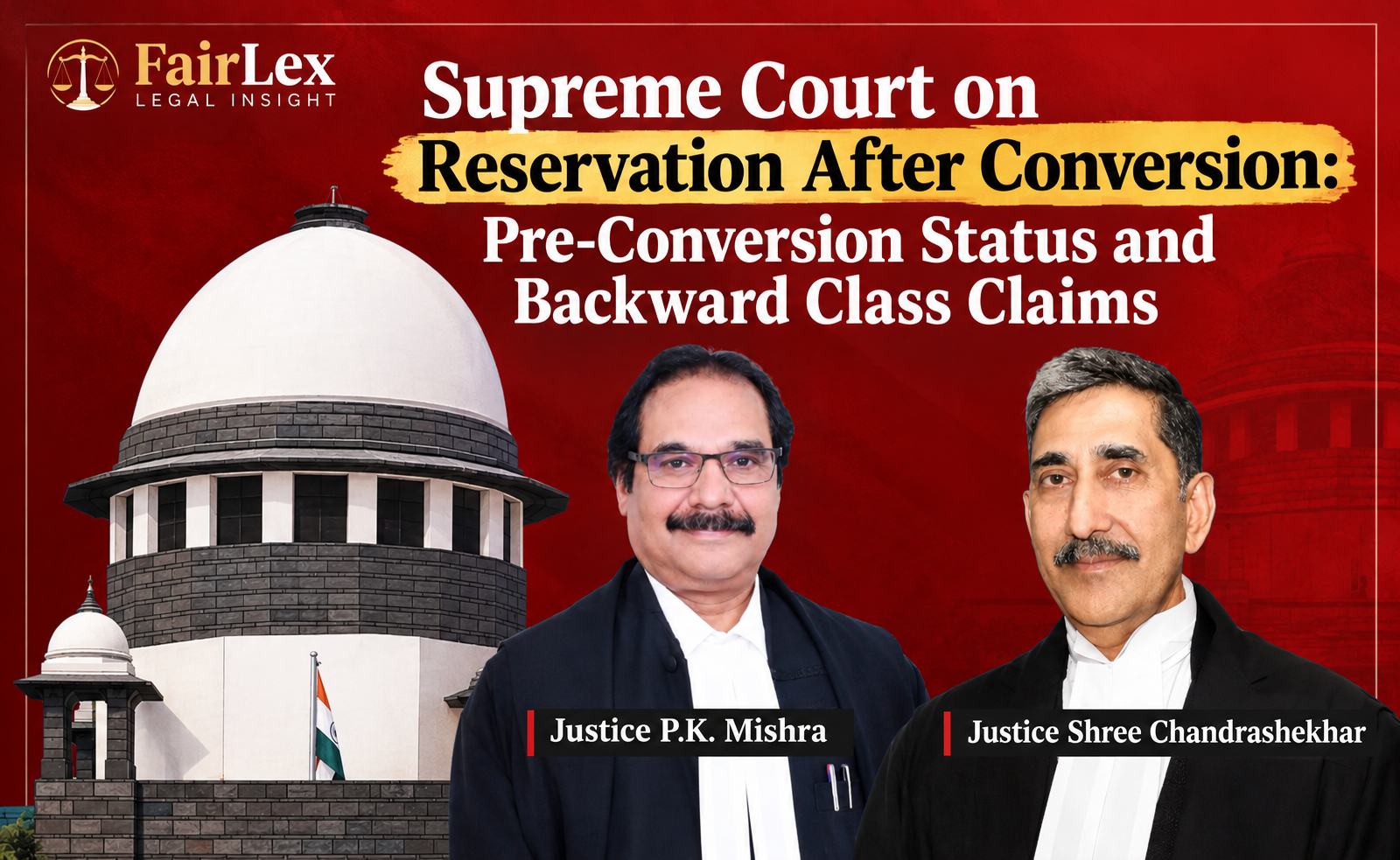
In The Secretary to Government v. Sameer Ahamed, the Supreme Court of India examined whether a person who converts from Hinduism to Islam can claim backward class reservation on the basis of their pre-conversion status. The Court upheld the judgment of the Madras High Court and held that a person who converts to Islam does not, by that act alone, become a member of one of the seven notified backward class Muslim communities.
The judgment also reaffirmed that a pre-conversion caste or community cannot be transposed into the post-conversion social order, that backwardness suffered under an antecedent social order cannot be carried forward, and that a private religious body cannot conclusively determine such status entitlement.
Facts of the Case
The respondent, Sameer Ahamed, converted from the Hindu religion to Islam in 2015, and a gazette notification recording the conversion was issued in 2016. He married as per Islamic rites and customs and has two children from the marriage.
Sameer applied for a community certificate certifying him as belonging to the “Muslim Lebbai” community. The Tahsildar rejected his application. Sameer approached the Madras High Court, claiming that, under a Government Order issued by the BC, MBC and MW Department on 9 March 2024, he was entitled to be issued the certificate.
The 2024 Government Order allowed a person who converted to Islam from the Backward Classes, Most Backward Classes, Denotified Communities or Scheduled Castes to be treated as BC (Muslim) and to be issued a community certificate as belonging to one of the seven notified sects, for the purpose of availing reservation upon conversion. The seven sects notified as Backward Class Muslims under the Tamil Nadu Backward Classes, Scheduled Castes and Scheduled Tribes (Reservation of Seats in Educational Institutions and of Appointments or Posts in the Services under the State) Act, 1993 are Ansar, Dekkani Muslims, Dubekula, Labbais (including Rowthar and Marakayar), Mapilla, Sheik and Syed.
A Bench of the High Court comprising Justice G.R. Swaminathan and Justice P.B. Balaji impleaded the State as a party to test the validity of the Government Order. The State argued that the order was not arbitrarily issued and that the Tamil Nadu Backward Classes Commission, by a letter dated 6 February 2024, had recommended that a community certificate be given to persons belonging to Backward Classes on conversion to any one of the seven identified groups. It was submitted that the order was passed after detailed deliberation, only to ensure that those who already enjoyed the benefits of reservation did not lose them on account of conversion to Islam, and that social balance would not be affected.
The High Court rejected these contentions and declared the Government Order unconstitutional, holding that it was strictly against the judicial pronouncements of the High Court and the Supreme Court, and that a person converting to Islam could only be treated as a Muslim. Challenging this decision, the State filed a Special Leave Petition before the Supreme Court on 6 July, through Advocate-on-Record B. Karunakaran.
The Main Issue
The central question before the Supreme Court was whether the High Court was justified in declaring the 2024 Government Order unconstitutional, that is, whether a person who converts from the Hindu social order to a non-Hindu social order can claim backward class status and affirmative action under Article 16(4) of the Constitution on the basis of the social backwardness associated with their pre-conversion status.
The Court also had occasion to consider the position of a person who converts to a non-Hindu religion and subsequently reconverts to the Hindu social order.
Supreme Court’s Analysis
A Bench of Justice Prashant Kumar Mishra and Justice Shree Chandrashekhar dismissed the challenge preferred by the Tamil Nadu Government and upheld the judgment of the Madras High Court. The Court held that a person who converts to Islam does not, by that act alone, become a member of one of the seven notified backward class social groups, nor can his private religious body conclusively determine such status entitlement.
On Article 16(4), the Court held that a person who converts from the Hindu social order to a non-Hindu social order cannot claim affirmative action merely on the basis of social backwardness associated with the pre-conversion status. Backwardness suffered on account of an antecedent social order cannot, by itself, be carried forward to confer upon a person the status of a backward class in the social order to which they have converted.
As regards Scheduled Castes, the Court referred to the Constitution (Scheduled Castes) Order. A person who professes a religion other than Hinduism, Sikhism or Buddhism cannot be deemed to be a member of a Scheduled Caste. Consequently, on conversion to a religion not specified in the Order, such a person ceases to possess Scheduled Caste status and cannot claim affirmative action or benefits under Article 16(4) that depend on membership of a Scheduled Caste.
The Court further clarified that conversion to a non-Hindu social order does not, by itself, confer membership of any particular backward caste community. A person’s pre-conversion caste or community status cannot, merely by reason of conversion, be transposed into a notified backward class community in the post-conversion social order, and the social backwardness that formed the basis of the pre-conversion status cannot by itself be the legal foundation for membership of a different notified backward class community after conversion.
On reconversion, the Court held that where a person converts from the Hindu social order to a non-Hindu social order and later reconverts to the Hindu social order, entitlement to affirmative action cannot be determined merely by reference to the antecedent status. It requires an independent, fact-specific assessment of whether the original caste or social identity has genuinely revived upon reconversion and whether the person has satisfied the applicable constitutional and legal requirements.
Ratio and Significance
The judgment reinforces that no benefit under Article 16(4), the enjoyment of which depends on a particular social order, can be claimed merely on the basis of antecedent membership after a person has converted to Islam, Christianity or any other non-Hindu social order. Such conversion severs the legal foundation of an entitlement conditioned upon membership of the Hindu social order.
It also establishes that a pre-conversion caste or community cannot be transposed into the post-conversion social order, and that conversion on its own does not make a person a member of any notified backward class community. The ruling effectively closes the route created by the 2024 Government Order, under which converts from backward communities were to be treated as BC (Muslim).
Further, the decision lays down that cases of reconversion must be decided on their own facts, through an independent assessment of whether the original identity has genuinely revived, and not by automatic reference to the person’s earlier status.
Conclusion
The Supreme Court dismissed the Special Leave Petition filed by the State of Tamil Nadu and upheld the Madras High Court’s judgment declaring the 2024 Government Order unconstitutional.
The judgment underscores that backward class and Scheduled Caste entitlements are tied to the social order in which the disadvantage was suffered, that conversion to a non-Hindu social order does not carry that status forward, and that claims after reconversion require a separate, fact-specific inquiry.
Continue Reading
Related Stories

Start the Conversation
Share your perspective on this article