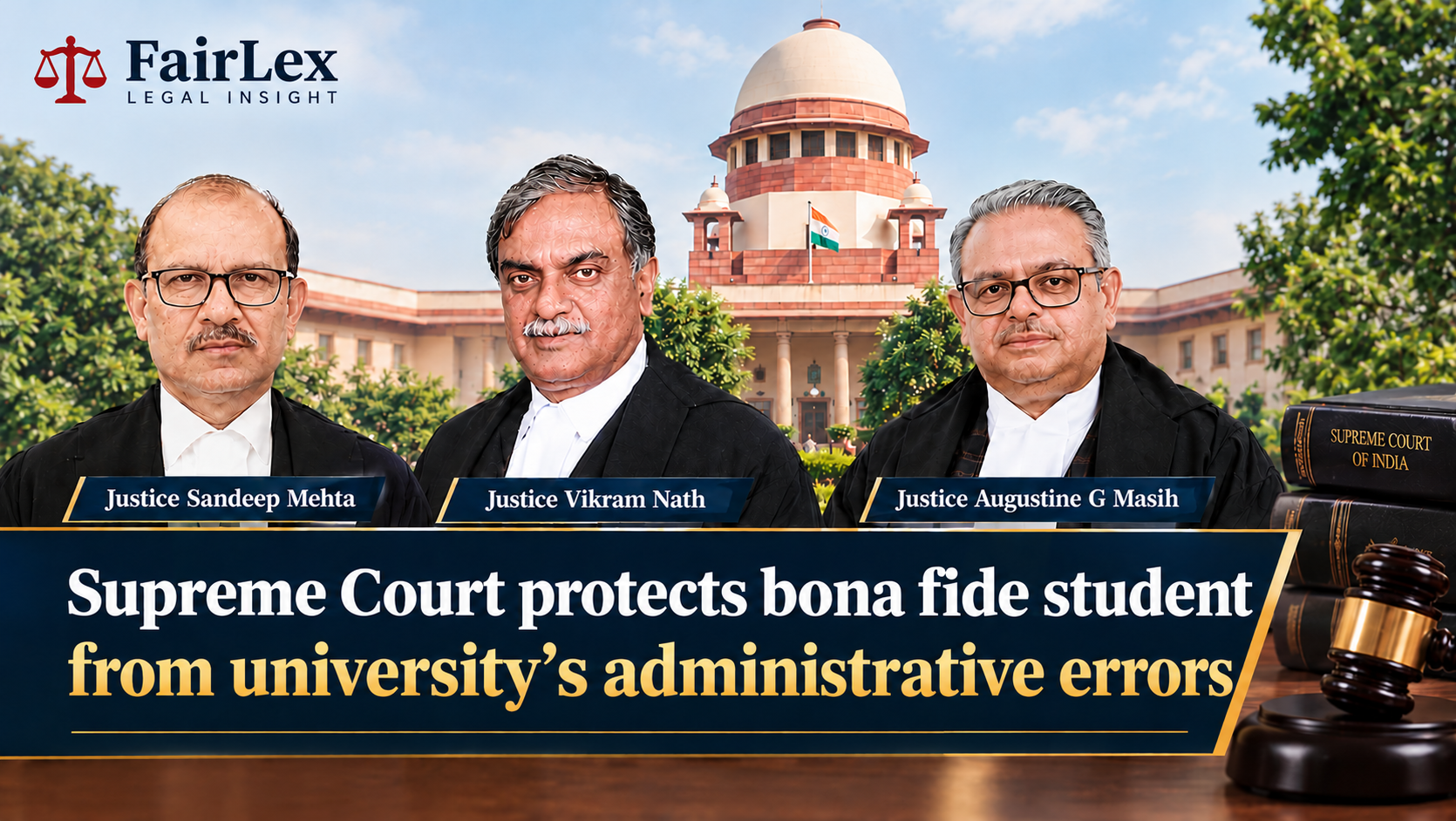
Supreme Court Protects Bona Fide Student from University’s Administrative Errors
Listen to Article
Prabhat VoiceListen to natural Indian English narration
Introduction
The Supreme Court of India, in Mohd. Asad Choudhary v. State of Himachal Pradesh and Others, decided on 14 October 2026, examined whether a student could suffer adverse consequences because of errors in university records that were beyond his control. The case arose from the prolonged non-verification of the appellant’s academic credentials, which affected the confirmation of his government appointment and the payment of his salary. The Court examined the university’s admissions and examination records, its counter-affidavit and an additional affidavit filed by the State’s Document Verification Committee. It concluded that the appellant’s established status as a bona fide student could not be undermined by the university’s admitted administrative lapse and that the remaining discrepancy required verification rather than a separate civil proceeding.
Facts of the Case
Mohd. Asad Choudhary was admitted to the B.Tech (Civil Engineering) course at Manav Bharti University, Himachal Pradesh, for the academic session 2014–2018. His admission number was R14BTCE0031, and his registration number was MBU-2014-0964. After completing all eight semesters, he received his Detailed Marks Certificates (DMCs), along with his Bonafide, Migration and Character Certificates dated 14 September 2018. His degree, dated 15 October 2018, recorded that he had passed the examination held in May 2018 in the first division.
Following his graduation, the appellant was appointed as a Sub-Inspector in the State Taxes Department, Jammu and Kashmir. However, the Additional Commissioner, State Taxes (Administration and Enforcement), Kashmir, sought verification of his degree through letters dated 19 May 2022, 22 September 2023 and 6 December 2023. A further letter dated 11 July 2024 recorded that verification remained pending and that his appointment was subject to verification of his academic certificates.
Meanwhile, allegations concerning the sale of degrees by the university resulted in criminal cases against its then administration, and its records were seized by the Special Investigation Team. Following an order of the Himachal Pradesh High Court dated 1 August 2022, the State Government constituted a Document Verification Committee through a notification dated 16 August 2022.
In a letter dated 26 July 2024, the university confirmed the appellant’s enrolment and the presence of his name in its Green Sheet and examination records. However, his name was absent from the admission disclosure list sent to the Himachal Pradesh Private Educational Institutions Regulatory Commission (HP-PERC). The university subsequently informed his employer on 16 November 2024 that he was its student and forwarded a copy of the Green Sheet.
On 20 December 2024, the High Court disposed of the appellant’s petition along with connected petitions, leaving the students to approach the competent court for redressal. The appellant challenged this decision before the Supreme Court.
Main Issues Before the Court
The principal issues were whether the university’s failure to include the appellant’s name in the admission disclosure list could justify withholding verification of his academic credentials; whether discrepancies between the university’s examination records invalidated his established academic qualification; and whether the appellant should be relegated to another court when the remaining question concerned verification of existing records.
Court’s Analysis and Findings
The Supreme Court examined the university’s counter-affidavit and the additional affidavit dated 18 September 2026 filed by the Superintendent of Police, Solan, who chaired the Document Verification Committee.
The university admitted that the appellant had been admitted against an allotted seat, had cleared all eight semesters, and had received his DMCs. It confirmed that his name appeared in the Green Sheet Register, which it identified as its primary internal record. The university attributed his omission from the admission disclosure list to a clerical and inadvertent human error by its previous administration.
The Court accepted this explanation, noting that it was consistent with the university’s letter dated 26 July 2024. It also found that the university’s explanation linking the omission from the disclosure list to the marks discrepancy was inconsistent because the disclosure list related to the 2014–2015 admission session, whereas the marks discrepancy concerned examinations conducted in December 2017 and May 2018. The Court therefore accepted the explanation that the omission resulted from the university’s own error.
The marks discrepancy required separate consideration. Paragraph 10 of the judgment records the seventh- and eighth-semester marks in the result gazette as 783/1300 and 920/1300, respectively. Paragraph 11, reproducing the university’s counter-affidavit, records the corresponding figures as 783/1300 and 926/1300. Both passages record the Green Sheet and DMC figures as 863/1300 and 946/1300. These figures are inconsistent, and the judgment does not conclusively identify the correct marks.
Nevertheless, the Court observed that the appellant’s results reflected a pass in both semesters under either set of figures. No respondent disputed that he had passed the examinations or completed the course. Accordingly, the discrepancy did not undermine his admission, student status or entitlement to the degree.
The Court held that the remaining question was which set of marks accurately reflected his performance. This required verification of the university’s existing records, not the creation or alteration of documents. The limited exercise did not justify relegating the appellant to a competent court.
Decision and Directions
The Supreme Court set aside the High Court’s order dated 20 December 2024 insofar as it concerned the appellant. It directed the State to provide the seventh- and eighth-semester result records available with the Committee to the university. The university was required to issue corrected DMCs and other consequential documents, where necessary, and forward the verification report to the appellant’s employer within three weeks.
Upon receipt of the verification, the employer was expected to release all outstanding salary arrears and consequential benefits within a further four weeks. The appeal was allowed, with no order as to costs.
Significance of the Judgment
The judgment demonstrates the importance of distinguishing a student’s established academic status from errors in the institution’s administrative records. It underscores that an omission expressly attributed by a university to its own clerical error cannot, in the circumstances established in this case, be used to penalise the student by withholding verification of his credentials.
The decision also illustrates the importance of resolving limited record-verification questions through the appropriate administrative process when the underlying qualification is established. Its directions connect the correction of academic records with the practical consequences of delayed verification for public employment and salary payments.
The judgment should, however, be understood within its factual limits. The Court did not determine the precise correct marks in the two semesters or lay down an unrestricted rule governing every dispute involving university records. It directed verification and correction in the appellant’s particular case.
Conclusion
In Mohd. Asad Choudhary v. State of Himachal Pradesh and Others, the Supreme Court granted relief to a bona fide student whose academic credentials remained unverified because of institutional errors and inconsistent records. By directing verification, correction of the relevant certificates and consequential salary payments, the Court ensured that the established qualification was not defeated by an avoidable administrative lapse. The judgment highlights the importance of accurate university records and fair administrative treatment where academic credentials affect employment and livelihood.
Continue Reading
Related Stories

Start the Conversation
Share your perspective on this article