Professional Course Fees Cannot Be Hiked Midway Except In Exceptional Cases: Supreme Court
Listen to Article
Prabhat VoiceListen to natural Indian English narration
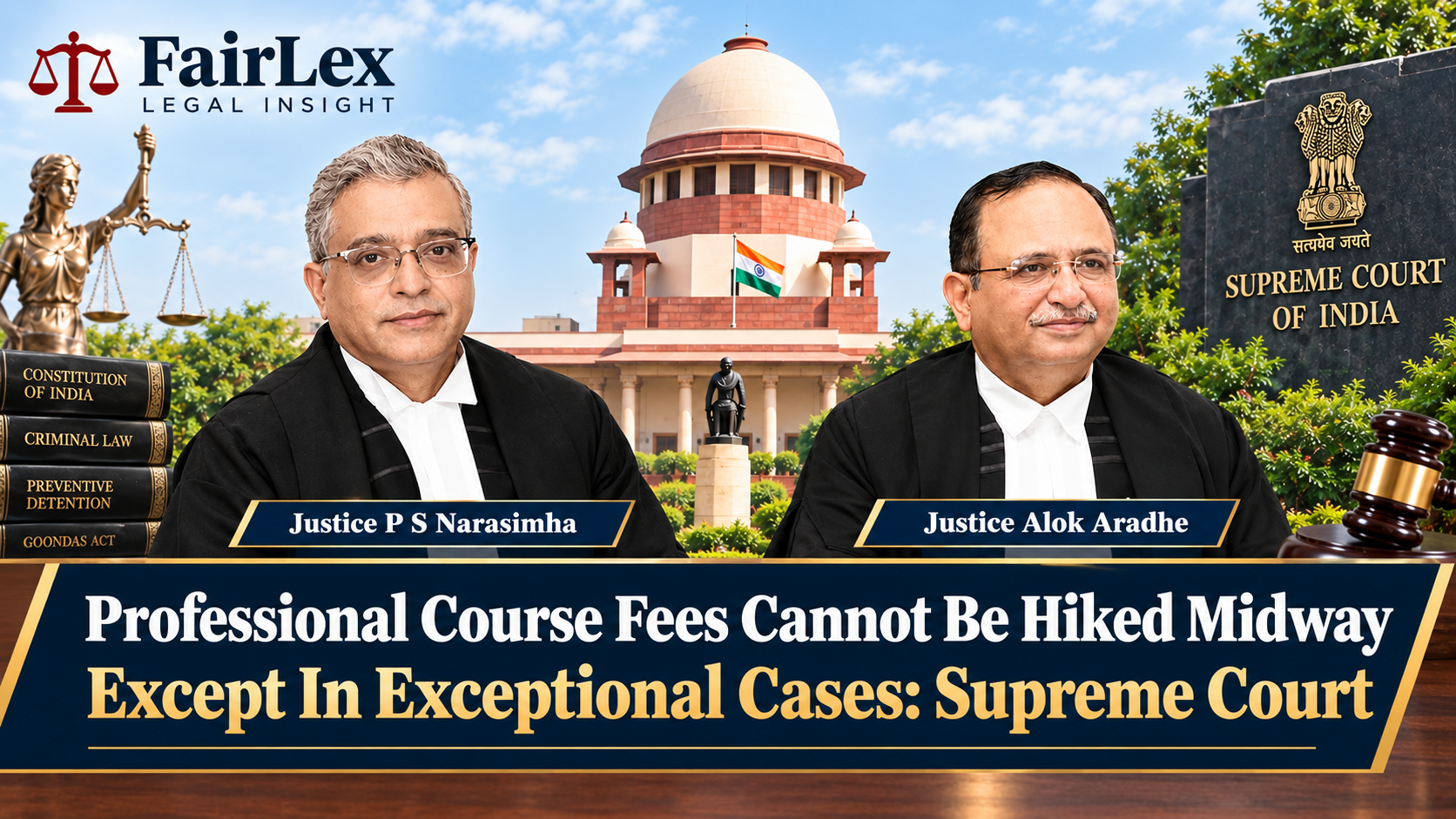
The Supreme Court has held that fees for professional courses must ordinarily be notified before admissions begin and remain applicable for the duration of the course. Any revision during an ongoing course must be confined to exceptional circumstances, such as unforeseen increases in expenditure. The Court emphasised that fee-fixation committees must function efficiently and make timely recommendations to prevent students from facing unexpected financial burdens after securing admission.
The Court made these observations while partly allowing appeals in Dr. B.C. Roy Engineering College & Anr. v. State of West Bengal & Ors. The dispute concerned the applicability of a revised fee structure to students admitted to a four-year B. Tech programme before the West Bengal Government issued its fee notification in October 2023.
A Bench of Justice Pamidighantam Sri Narasimha and Justice Alok Aradhe delivered the judgment on October 14, 2026.
Facts of the Case
The dispute arose after students were admitted to the B. Tech programme at Dr. B.C. Roy Engineering College for the 2023–2027 academic session. At the time of admission, the students were informed of the applicable fee structure through the college prospectus.
On October 16, 2023, after the admission process had concluded, the West Bengal Government issued a notification prescribing a revised fee structure for self-financing technical institutions. The notification fixed the maximum annual tuition fee at ₹1.10 lakh and laid down rules governing other charges.
The college subsequently adopted the revised structure on December 15, 2023, and introduced an additional development fee. The revised charges were applied from January 2024, during the students’ ongoing course, resulting in a reported increase of 37.5%.
The students challenged the revision insofar as it applied to those admitted before the notification. The Calcutta High Court’s Division Bench ruled that the revised structure could not be applied to students whose admissions had concluded before October 16, 2023. It directed that the additional amounts collected be refunded or adjusted.
The college and the State authorities approached the Supreme Court against the High Court’s decision.
Main Issue
The central question before the Supreme Court was whether a revised fee structure could be applied to students already enrolled in a professional course, when the revision was notified after their admission.
The Court also examined the obligations of fee-fixation committees, the regulatory framework governing fee revisions, and the need to balance the financial requirements of educational institutions with students’ need for certainty regarding the cost of their education.
Supreme Court’s Observations
1. Fees Must Ordinarily Be Fixed Before Admission
The Supreme Court emphasised that students and their families must have reasonable certainty about the financial commitment involved in pursuing a professional course. An unexpected fee increase after admission can place considerable pressure on families, particularly where education is financed through loans or other borrowed funds.
The Court recognised that educational institutions also require adequate financial resources to maintain standards and develop their infrastructure. However, these requirements must be balanced against the interests of students and the broader public interest in ensuring that professional education remains reasonably accessible.
The Court, therefore, held that the fee payable for the entire course should ordinarily be notified before admission. Students should not be exposed to unpredictable revisions after enrolling in a programme.
2. Mid-Course Fee Revision Must Remain Exceptional
The Court clarified that the fee structure is not absolutely immune from revision throughout the duration of a course. However, a change during an ongoing course must be justified by exceptional circumstances, including unforeseen extraordinary increases in expenditure, changes in statutory requirements or other circumstances that could not reasonably have been anticipated.
Such revisions cannot become a routine method of adjusting fees after students have already committed to a course. The regulatory framework must be interpreted to ensure that institutions’ legitimate financial needs do not undermine the certainty required by students at the time of admission.
The Court also stressed that fee revisions must comply with the applicable regulatory requirements, including the prescribed interval between revisions and the assessment of expenditure and financial needs.
3. Fee-Fixation Committees Must Act Efficiently and Independently
The Supreme Court underscored the public function performed by fee-fixation committees. Their role is not limited to determining the amount institutions may charge; they must balance institutional requirements with students’ interests and the public interest in reasonable fees.
The Court observed that such committees must possess the necessary expertise, integrity and efficiency to discharge their responsibilities. Their recommendations must be based on a proper assessment of expenditure, audited financial information and projected requirements.
The Court further stated that High Courts may exercise judicial review to ensure that these committees perform their functions effectively and in accordance with law.
4. Regulatory Authorities Cannot Justify Delayed Fee Notifications
The Court noted that the fee-revision process in West Bengal had been marked by a prolonged delay. The previous revision dated back to the 2016–2017 academic session, while the subsequent notification was issued only on October 16, 2023.
Although an expert committee had been constituted in 2019 and recommendations were adopted by the fee committee in June 2023, the notification came after admissions for the relevant academic session had concluded.
The Court observed that timely action by the regulatory authorities could have prevented the dispute. Fee-fixation committees and the State must anticipate the financial requirements of educational institutions and complete the revision process sufficiently early for students to know the applicable fees before admission.
5. The Court Distinguished Its Findings From the High Court’s Reasoning
While upholding the High Court’s operative directions concerning the applicability of the revised fees, the Supreme Court disagreed with certain aspects of its reasoning.
It did not agree with the High Court’s characterisation of the revised fee structure’s application to the 2023–2027 batch as retrospective. It also set aside the High Court’s reliance on equity and estoppel against the college on the basis of its prospectus.
Nevertheless, the Court maintained the directions protecting the students admitted before the revised notification. It clarified that its decision rested on the governing regulatory framework and the requirement that fees ordinarily be notified before admission.
Final Decision
The Supreme Court partly allowed the appeals while affirming the High Court’s directions regarding the applicability of the revised fee structure to the students concerned.
The Court laid down that fee-fixation committees must perform their public functions efficiently and that fees for an entire course should ordinarily be notified before admission. Revisions during the course may be considered only in exceptional circumstances, such as unforeseen increases in expenditure. The college was directed to comply with the High Court’s operative directions. The Court also clarified that each party would bear its own costs.
Legal Significance
The judgment reinforces the need for predictability and transparency in the regulation of professional education fees. While recognising that educational institutions require adequate resources to maintain educational standards, the Supreme Court made clear that financial adjustments cannot ordinarily be imposed on students after their admission.
The ruling also places responsibility on State authorities and fee-fixation committees to complete the revision process on time. By emphasising institutional efficiency and the availability of judicial review, the Court sought to ensure that regulatory delays do not translate into unexpected financial burdens for students.
Conclusion
In Dr. B.C. Roy Engineering College & Anr. v. State of West Bengal & Ors., the Supreme Court reaffirmed that fee structures should ordinarily be settled before students enter a professional course. Although exceptional circumstances may justify a mid-course revision, such changes cannot become routine. The judgment highlights the importance of timely regulatory action and a balanced approach that protects students’ financial certainty while recognising the legitimate needs of educational institutions.
Continue Reading
Related Stories


Start the Conversation
Share your perspective on this article